Message the manager to join our researchers' chat
Ask a question manager online
UK RU EN
Мова
UK RU EN
Валюта
Shopping Cart
Catalog /Research Chemicals /BAM15 powder
In Stock
BAM15 powder

BAM15 powder

BAM15 · BAM-15 · BAM 15 · БАМ15 · БАМ-15 · мітохондріальний розʼєднувач · митохондриальный разобщитель · mitochondrial uncoupler · protonophore · протонофор · фуразано[3,4-b]піразин

Purity ≥98% HPLC · PASS
Specification
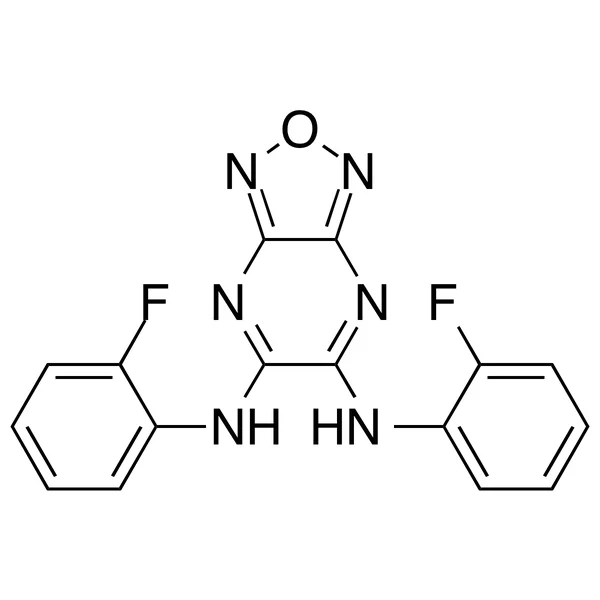
IUPACN5,N6-Bis(2-fluorophenyl)[2,1,3]oxadiazolo[4,5-b]pyrazine-5,6-diamine
CAS210302-17-3
FormulaC₁₆H₁₀F₂N₆O
Mol. weight340.29 г/моль
Purity≥98% · HPLC
Formpowder
PubChemCID 565708
Place an order
$13.00
1
● In stock · we ship today before 17:00
Purity ≥98%, verified by HPLC
CoA for every lot
Nova Poshta, 1–2 days in Ukraine
Payment by card or USDT
Compound description

What is BAM15 powder

BAM15 is a mitochondrial protonophore uncoupler. As a lipophilic weak acid it carries protons across the inner mitochondrial membrane bypassing ATP synthase: the proton gradient dissipates, substrate oxidation is no longer coupled to ATP synthesis, and the cell begins spending energy as heat. Uncoupling of oxidative phosphorylation in L6 myoblast mitochondria occurs with an EC₅₀ of 270 nM (Kenwood et al., Mol Metab 2014).

Why the class needed a new molecule. Uncouplers are a classic bioenergetics tool, but nearly all of them carry off-target activity: they depolarise the plasma membrane, inhibit the mitochondrion itself and produce cytotoxicity. This makes results hard to interpret — it is unclear which effect comes from uncoupling and which from the side actions (Mol Metab, 2014).

BAM15's key distinction. It does not depolarise the plasma membrane — a point placed directly in the title of the paper that identified it (Kenwood et al., Mol Metab 2014). The action stays inside the mitochondrion while the electrical properties of the cell membrane remain untouched. Experimentally this means the observed effect genuinely belongs to uncoupling.

Direct comparison with FCCP. At 1–10 µM, BAM15 increased oxygen flux with the same potency as the classic uncoupler FCCP, while delivering a higher maximum rate of mitochondrial respiration and less cytotoxicity (Kenwood et al., Mol Metab 2014). The mitochondrion can be driven harder without killing the cell.

Obesity and insulin resistance. Two independent studies appeared in the same year, 2020. The first showed that BAM15 reverses diet-induced obesity and restores insulin sensitivity in mice (Alexopoulos et al., Nat Commun 2020). The second, that uncoupling with BAM15 protects against obesity and improves glycaemic control (Axelrod et al., EMBO Mol Med 2020). The logic is straightforward: if energy goes to heat rather than ATP, surplus calories are not stored.

Renal protection. BAM15 protected mice from acute renal ischaemia-reperfusion injury (Kenwood et al., Mol Metab 2014). The mechanism here differs from the metabolic one: mild uncoupling reduces reactive oxygen species formation at the moment blood flow is restored, which is when most of the damage occurs.

Lifespan and neurodegeneration. In ageing Caenorhabditis elegans, BAM15 relieved neurodegeneration and extended lifespan (Cho et al., Metabolites 2022). For an uncoupler this is a non-trivial result: it shows that a controlled loss of mitochondrial efficiency can act as hormesis rather than harm.

Other directions. BAM15 reduced apoptosis in retinal tissue differentiated from induced pluripotent stem cells during transportation (Tang et al., Stem Cell Res Ther 2019) — a practical application for preserving cellular material.

Origin. The molecule emerged from a systematic structure-activity study of a series of furazano[3,4-b]pyrazines as uncouplers (Kenwood et al., Bioorg Med Chem Lett 2015). The two ortho-fluorophenyl groups on the oxadiazolo-pyrazine core are the product of that screen.

Supplied as a powder, purity ≥98% (HPLC), CAS 210302-17-3.

For research use only. This product is not a medicine, food supplement or cosmetic. Not intended for human or animal use. Sold to persons aged 18+.