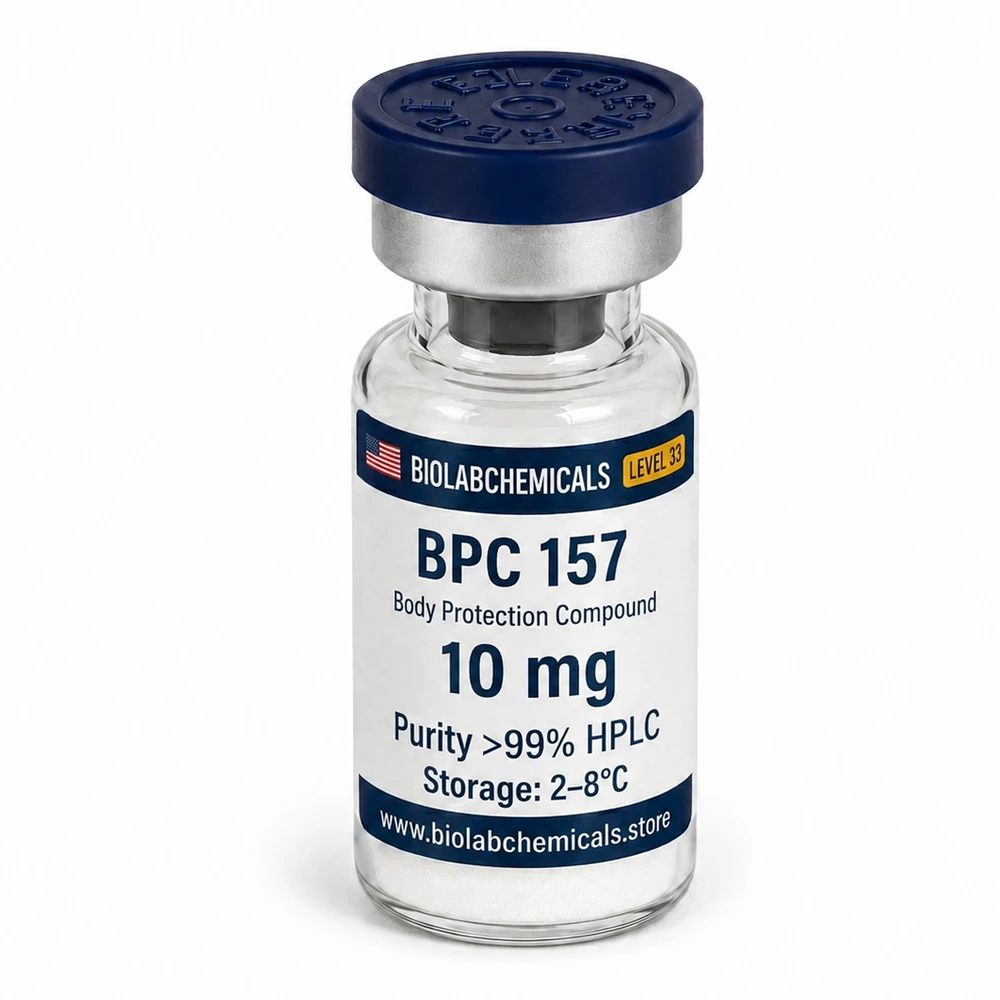
BPC-157 (Body Protection Compound-157) is an injectable synthetic pentadecapeptide of 15 amino acids (sequence GEPPPGKPADDAGLV) corresponding to a fragment of a protective protein in human gastric juice (also known as PL 14736 and Bepecin). The key to understanding this peptide: the stomach lining is damaged every day by hydrochloric acid and enzymes and must renew itself constantly — it is one of the fastest-renewing tissues in the body. BPC-157 is naturally and continuously present in gastric juice and the mucosa, where it is one of the key mediators of this daily protection and renewal of the epithelium (the innate 'Robert cytoprotection' concept). It is precisely this built-in ability to sustain the daily regeneration of the body's most aggressive environment that makes BPC-157 one of the most powerful regenerative peptides known, with activity that extends from the stomach to other tissues. It is also water-soluble and stable in gastric juice for over 24 hours.
Mechanism of Action
BPC-157 acts not through a single receptor but through simultaneous modulation of several signaling pathways. It boosts angiogenesis via the VEGFR2–Akt–eNOS axis and the nitric oxide (NO) system, forming new blood vessels and restoring blood supply to damaged tissue. Four key molecular pathways are involved, each with its own role. The Egr-1 gene (early growth response 1) is the 'master switch' of healing: it turns on genes for cell growth and migration, angiogenesis, and the production of growth factors and cytokines. Its co-repressor NAB2 acts as a 'brake' paired with Egr-1, restraining excessive vessel growth so that regeneration proceeds in an organized, non-chaotic way. The FAK–paxillin pathway governs cell adhesion and migration: fibroblasts and other cells move into the injury site and anchor themselves to rebuild tissue. The JAK-2 pathway (the JAK–STAT cascade) relays signals from outside the cell to the nucleus, controlling cell survival, division and immune responses during healing. In parallel, BPC-157 enhances fibroblast migration, collagen deposition and extracellular-matrix remodeling, producing marked cytoprotective and regenerative effects.
Effects in Research
In preclinical (mostly rodent) models, BPC-157 accelerates healing of skin wounds, muscle tears, and tendon and ligament injuries. Its action in the gastrointestinal tract is especially well studied: it heals gastric and duodenal ulcers, gastritis, and mucosal lesions caused by alcohol and NSAIDs (aspirin, indomethacin), protects the esophagus, and restores tight-junction proteins (occludin, claudin) in 'leaky gut'. The peptide (as PL 14736) was tested in clinical trials for ulcerative colitis. Anti-inflammatory and neuroprotective effects and influence on the dopaminergic and serotonergic systems have also been described. Effective doses in rodents are on the order of 10–100 µg/kg.
Key Research
Most of the data come from P. Sikirić's group (Zagreb), which has studied the peptide in animals systematically since the 1990s. In Achilles- and quadriceps-transection models, BPC-157 accelerated healing and improved function, linked to activation of the FAK–paxillin pathway and tendon-fibroblast outgrowth. In gastroenterology, the peptide (as PL 14736) was investigated in inflammatory bowel disease. Importantly, the overwhelming majority of the evidence is preclinical (animal models), with limited human data; in 2022 WADA added BPC-157 to its list of substances prohibited in sport.
Properties
White lyophilized powder, soluble in water. Sequence: Gly-Glu-Pro-Pro-Pro-Gly-Lys-Pro-Ala-Asp-Asp-Ala-Gly-Leu-Val. Formula C₆₂H₉₈N₁₆O₂₂, molecular weight ≈1419.5 Da. CAS 137525-51-0, PubChem CID 9941957.
Storage
Store the lyophilized powder at 2–8°C in a dry place protected from light; for long-term storage −20°C is optimal. After reconstitution keep refrigerated, do not freeze, and use within a few weeks.
 BIOLABCHEMICALS