MOTS-c (Mitochondrial ORF of the 12S rRNA type-c) is an injectable mitochondrial-derived peptide of 16 amino acids (sequence MRWQEMGYIFYPRKLR). Its uniqueness lies in being encoded not in nuclear but in mitochondrial DNA — within the 12S rRNA gene region, previously not thought to produce proteins. First described in 2015, MOTS-c belongs to a new class of mitochondrial-derived peptides (MDPs) that act as signaling hormones governing cellular energy metabolism.
Mechanism of Action
The main pathway of MOTS-c is activation of the energy sensor AMPK. The peptide interferes with the cell's folate-methionine cycle, leading to accumulation of AICAR (a natural AMPK activator); activated AMPK enhances glucose uptake and fatty-acid oxidation independently of insulin. Under metabolic stress MOTS-c translocates from the mitochondria into the nucleus, where it regulates nuclear gene expression (antioxidant response elements, ARE, as well as GLUT4, STAT3, IL-10, PGC-1α), restoring homeostasis. In addition, MOTS-c triggers mitochondrial biogenesis (raising TFAM, COX4, NRF1) and, at the same time, mitochondrial fusion (the GTPases OPA1 and MFN2) — and this fusion is precisely what is required for translocation of the glucose transporter GLUT4. In muscle, the peptide lowers myostatin (a negative regulator of muscle mass): by increasing AKT phosphorylation it inhibits the transcription factor FOXO1, which switches on muscle-atrophy genes. Another mechanism is interaction with the STAT3 protein (via a motif in the YIFY region): MOTS-c dampens IL-6-induced STAT3 activity, thereby enhancing myotube formation and muscle differentiation.
Effects and Research Applications
MOTS-c is often called the "mitochondrial hormone" and an "exercise mimetic": it improves metabolic flexibility, lowers insulin resistance, and boosts glucose uptake and fat oxidation. Endogenous plasma MOTS-c declines with age and rises in response to exercise, which is why it is linked to the anti-aging effects of physical activity. In preclinical and early studies it is investigated in type 2 diabetes and obesity (including postmenopausal); cardiovascular complications of diabetes (improved endothelial function, restoration of myocardial mitochondria); osteoporosis (stimulating osteoblasts and suppressing osteoclasts); sarcopenia and muscle atrophy (via reduced myostatin); neurodegeneration, notably Alzheimer's disease; pulmonary fibrosis; and Duchenne muscular dystrophy (MOTS-c has innate muscle-targeting and, in mdx mice, boosted delivery of therapeutic oligomers). To date the evidence base is mostly preclinical (cells and animals), with limited human data.
Key Research
MOTS-c was first described by Lee et al. (Cell Metabolism, 2015), showing AICAR–AMPK activation and protection against insulin resistance and obesity in mice. Later, Reynolds et al. (Nature Communications, 2021) demonstrated that MOTS-c administration boosts physical performance in young, adult and old mice, and that the peptide is a mitochondrially encoded regulator of age-dependent physical capacity. To date the evidence base is mostly preclinical (cells and animals), with limited human data.
Properties
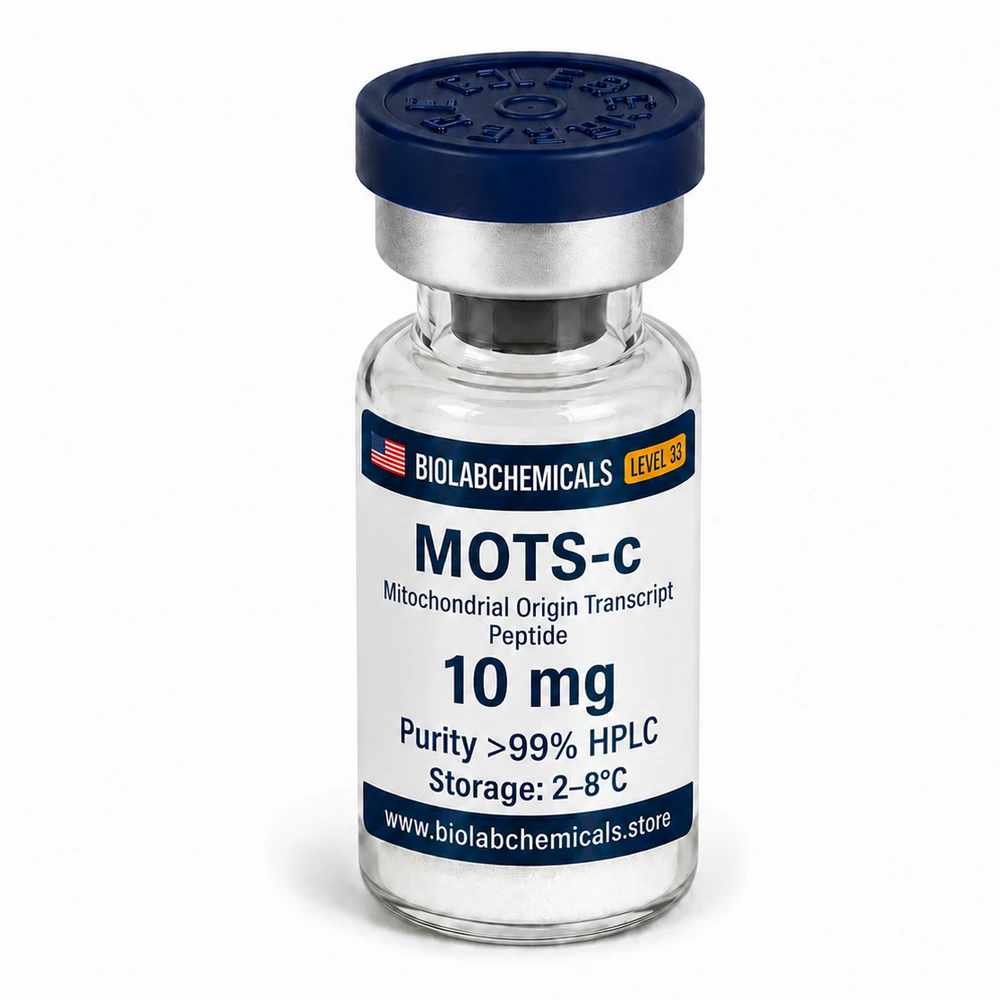
White to off-white lyophilized powder, soluble in water. Sequence: Met-Arg-Trp-Gln-Glu-Met-Gly-Tyr-Ile-Phe-Tyr-Pro-Arg-Lys-Leu-Arg. Formula C₁₀₁H₁₅₂N₂₈O₂₂S₂, molecular weight ≈2174.6 Da. CAS 1627580-64-6, PubChem CID 146675088 (UNII A5CV6JFB78).
Storage
Store the lyophilized powder at 2–8°C in a dry place protected from light; for long-term storage −20°C is optimal. After reconstitution keep refrigerated, do not freeze, and use within a few weeks.
 BIOLABCHEMICALS