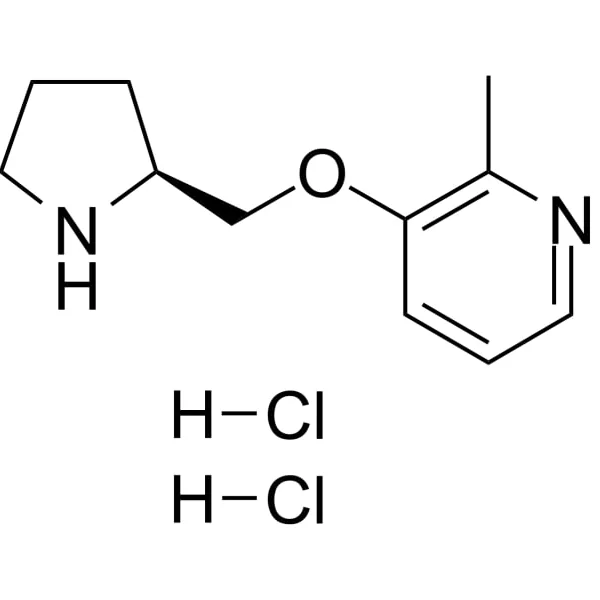
ABT-089 dihydrochloride powder (Pozanicline)
ABT-089 · ABT 089 · ABT089 · АБТ-089 · ABT-089 dihydrochloride · ABT-089 2HCl · Pozanicline · Pozanicline dihydrochloride · позаніклін · позаниклин · позанiклiн дигідрохлорид · α4β2 nAChR агоніст
ABT-089 is a selective ligand of neuronal nicotinic acetylcholine receptors developed by Abbott. Its international nonproprietary name is pozanicline (Wikipedia). We supply it as the dihydrochloride: a stable crystalline salt, CAS 161416-61-1 — the exact form used in Abbott's original studies.
Target and selectivity. ABT-089 acts on the α4β2 nicotinic receptor subtype with a Ki of 16 nM and also binds α6β2. The selectivity is striking: affinity for α7 receptors exceeds 10 µM, a difference of more than six hundredfold (Probechem). Binding to [³H]cytisine sites occurs with a Ki of 16.7 nM and to rat brain α4β2 receptors with a Ki of 17 nM, while binding to α7 is insignificant (MedChemExpress).
The key feature is separating two of nicotine's effects. ABT-089 facilitates acetylcholine release with potency and efficacy comparable to nicotine (EC₅₀ 3 µM). Yet it is far weaker at stimulating dopamine release: EC₅₀ 1.1 µM versus 0.04 µM for nicotine — roughly twenty-seven times weaker (Probechem). The molecule effectively decouples the cholinergic component from the dopaminergic one.
Oral bioavailability. This was one of the central design goals. ABT-089 was created as a 3-pyridyl ether with improved oral bioavailability and a reduced adverse-effect profile relative to nicotine (J Med Chem, 1997). It is this combination of good bioavailability with receptor selectivity that sets it apart from earlier nicotinic ligands.
Cognitive effects. In a series of Abbott studies the compound was tested across a broad range of cognitive tasks in both rats and monkeys — a level of evidence rare for research compounds (Decker et al., JPET 1997). A separate study showed that central nicotinic agonists including ABT-089 reduce distractibility in adult monkeys (AbMole). Wikipedia classifies pozanicline as a compound with nootropic and neuroprotective effects (Wikipedia).
Neuroprotection. The compound's original characterisation describes it as a potent and selective cholinergic channel modulator with neuroprotective properties (J Pharmacol Exp Ther, 1997). This combination — cognitive effect plus neuronal protection — is what made α4β2 agonists an attractive direction.
Other directions. The compound has been investigated for alleviating symptoms of nicotine withdrawal, particularly cognitive deficits and anxiety (AbMole), as well as in the context of Alzheimer's and Parkinson's disease (MedChemExpress).
Important for calculations. The molecular weight of the dihydrochloride is 265.18 versus 192.26 for the free base — a difference of almost 38%. Weighed amounts must be calculated using the salt's mass, otherwise the error will be substantial.
Supplied as a crystalline powder, purity ≥99%, CAS 161416-61-1.