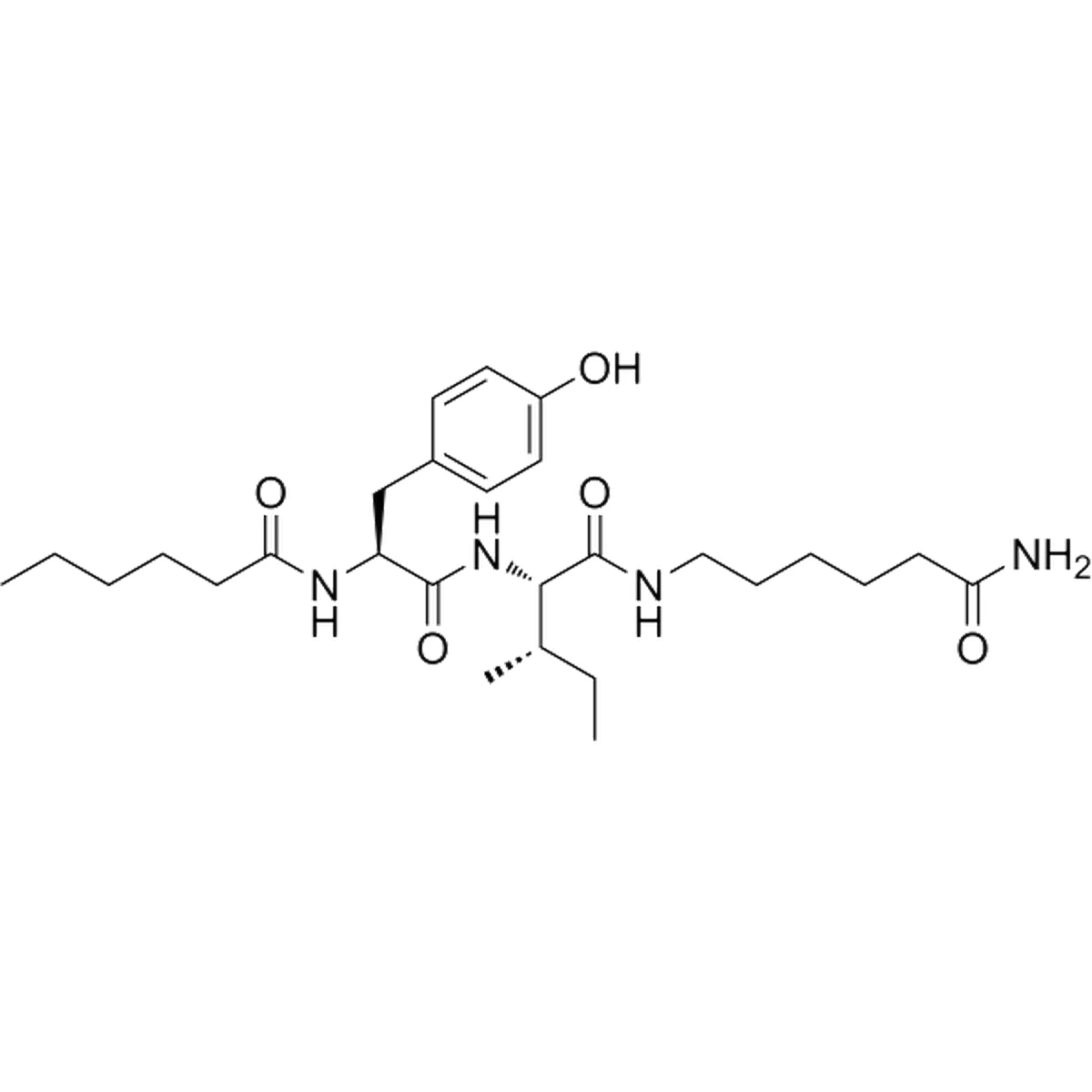
Dihexa powder (PNB-0408)
Dihexa · PNB-0408 · HGF/c-Met potentiator
Dihexa (PNB-0408, N-hexanoic-Tyr-Ile-(6) aminohexanoic amide) is a synthetic angiotensin IV analogue designed as a potent activator of neurotrophic signalling.
What makes it exceptional. Peptides are usually unsuitable for oral dosing: they degrade rapidly and do not reach the brain. Dihexa was specifically re-engineered to overcome both limitations — the molecule is metabolically stable, orally active and brain-penetrant. That is a rare combination for a peptide-derived compound.
Mechanism: the HGF/c-Met axis. Dihexa acts through hepatocyte growth factor (HGF) and its receptor c-Met. By amplifying HGF signalling at c-Met it switches on the intracellular PI3K/Akt and MAPK/ERK cascades — precisely those that govern synaptogenesis, neuroplasticity and neuronal survival.
Activity at picomolar concentrations. In cellular synaptogenesis assays dihexa is active at concentrations on the order of 10⁻¹² M — picomolar. For comparison, in the same type of assay the neurotrophic factor BDNF requires concentrations several orders of magnitude higher. This refers specifically to sensitivity in a particular cell assay of dendritic spine density.
Three independent confirmations of the mechanism. The strongest element of dihexa's profile is that its action has been reproduced by groups unconnected to the original discoverers:
• Siller (2015) — dihexa replaced the HGF protein itself in a protocol converting human pluripotent stem cells into hepatocytes. The functional substitution worked, meaning the molecule genuinely switches the signal on.
• Pan (2022) — a second independent group reproduced the same approach in a fully small-molecule protocol. Reproduction in another laboratory makes the conclusion robust.
• Sun (2021) — a Chinese group working with APP/PS1 amyloid-pathology mice showed restoration of spatial learning with oral dosing (1.44–2.88 mg/kg, 3 months): neuron and synaptophysin counts rose, astrocyte and microglial activation fell, IL-1β and TNF-α dropped and anti-inflammatory IL-10 increased. The effect was abolished by a PI3K inhibitor — placing the mechanism on PI3K/AKT.
Applications beyond cognition. Uribe (2015) demonstrated otoprotection: at 1 μM, dihexa protected auditory hair cells from two ototoxic aminoglycosides — neomycin and gentamicin. Tellingly, it did not prevent the antibiotic from entering the cell, so it acted from within; the effect was abolished by an HGF antagonist and by Akt, TOR and MEK inhibitors, again pointing to the same axis.
Origin. Developed in the 2000s and early 2010s at Washington State University as a candidate treatment for Alzheimer's disease and other neurodegenerative conditions. Chemically it is the product of deliberate optimisation: first the minimal active fragment of angiotensin IV was identified — the tripeptide Nle-Tyr-Ile — and then stabilised into an orally usable molecule.
As of today dihexa is not registered as a medicine in any country and has not been trialled in humans in its own right; its human pharmacokinetic parameters remain uncharacterised.
It is used as a research compound for studying neuroplasticity, synaptogenesis and HGF/c-Met signalling.