UK RU EN
Shopping Cart
← Catalog TAK-653 powder (Osavampator, NBI-1065845)
Very Rare In Stock

TAK-653 powder (Osavampator, NBI-1065845)

C₁₉H₂₃N₃O₃S
$100.00
1
CAS № 1358751-06-0
PubChem CID 56655833
Purity ≥98%
Category Research Chemicals
Description
TAK-653 (Osavampator, NBI-1065845) is a first-in-class selective positive allosteric modulator (PAM) of AMPA receptors, being developed by Neurocrine Biosciences (licensed from Takeda) for major depressive disorder (MDD), including treatment-resistant cases.

Mechanism of Action
AMPA receptors (GluA1–GluA4) are ionotropic glutamate receptors responsible for fast excitatory synaptic transmission. TAK-653 binds to the ligand-binding domain of AMPA-R in a strictly glutamate-dependent manner via structural interference at Ser743 in the GluA1 subunit: without endogenous glutamate, the compound does not activate the receptor. When glutamate is released, TAK-653 slows desensitization and internalization of AMPA-R. EC₅₀: 3.3 µM (Ca²⁺ influx, CHO cells) and 4.4 µM (EPSP potentiation in primary rat hippocampal neurons).

BDNF/mTOR Cascade
AMPA receptor activation triggers a BDNF-mediated mTOR signaling cascade — the same downstream pathway through which ketamine (by blocking NMDA-R and indirectly activating AMPA-R) produces its rapid antidepressant effect. TAK-653 activates this cascade directly via AMPA-R, without the dissociative and psychotomimetic effects of ketamine.

Key Difference from Other AMPA PAMs
Earlier potentiators (LY451646, etc.) had intrinsic agonistic activity → excitotoxicity and seizures in animal models. TAK-653 lacks this liability.

In Vivo Confirmation (Human PET)
Dijkstra et al. conducted a CNS PET study in healthy volunteers: a single oral dose of TAK-653 increased AMPA-mediated cortical signaling within hours, confirming CNS penetration and target engagement in the living human brain.

Cognitive and Behavioral Effects
Improved verbal fluency, enhanced emotional stability, and neutralization of the negative cognitive bias characteristic of depression. Preclinical: improved visual learning and memory (0.03–0.3 mg/kg p.o.), sustained attention (0.3 mg/kg), and working memory in primates (0.06 mg/kg); antidepressant-like effect in the RSBM model (1 mg/kg). No seizures or excitotoxicity at therapeutic doses.

Clinical Data — Phase 2 SAVITRI (NCT05203341)
183 adults with MDD and inadequate response to ≥1 antidepressant were randomized 2:1:1 (placebo / Osavampator 1 mg / 3 mg q.d., 8 weeks). Statistically significant and clinically meaningful MADRS improvement at 1 mg/day, good tolerability (April 2024). Neurocrine launched a five-study Phase 3 program (initiated January 2025). T½ 33.1–47.8 h.

Physicochemical Properties
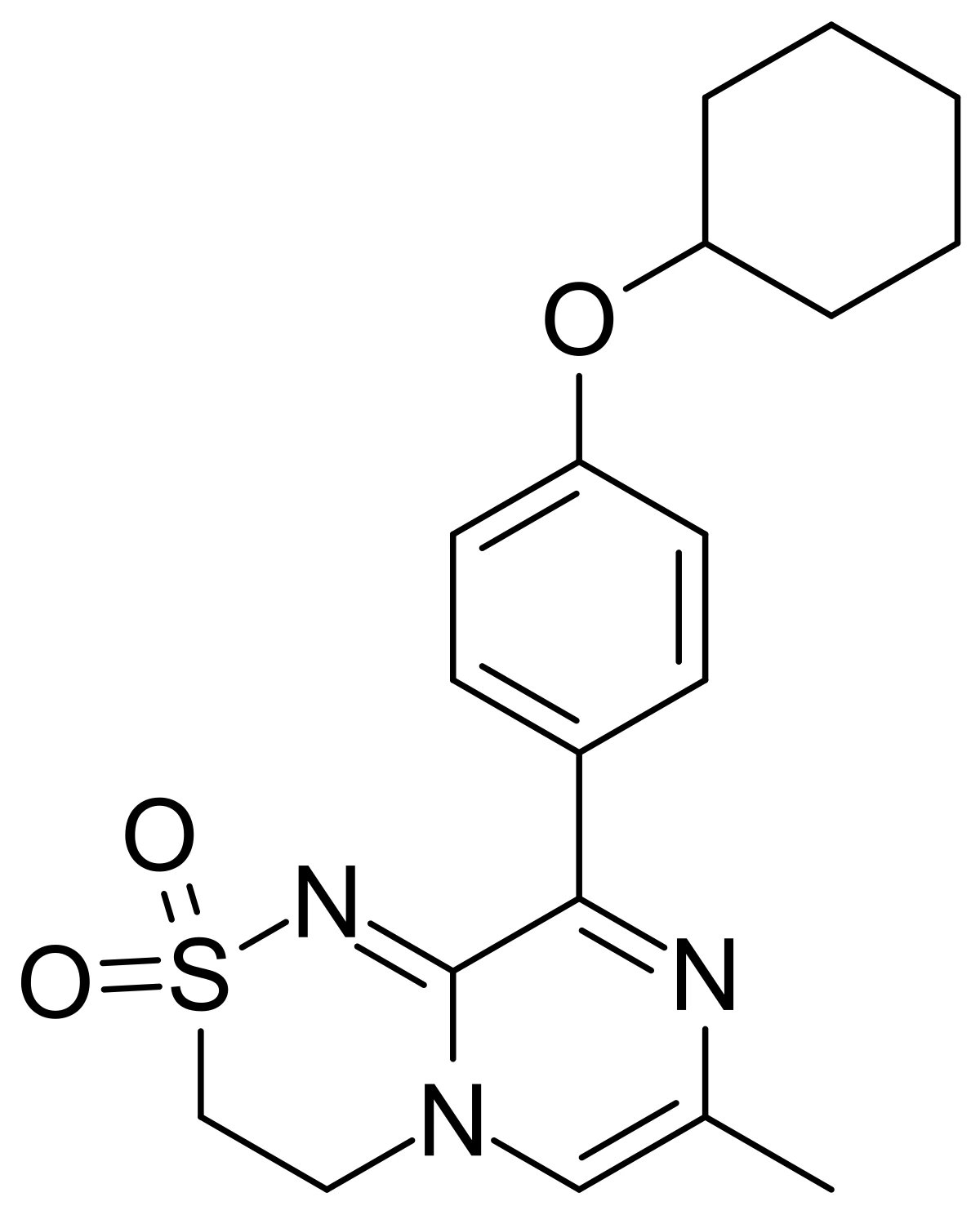
Molecular weight: 373.48 g/mol. Appearance: white to off-white powder. IUPAC: 9-(4-(cyclohexyloxy)phenyl)-7-methyl-3,4-dihydropyrazino[2,1-c][1,2,4]thiadiazine 2,2-dioxide. Soluble in DMSO (≥75 mg/mL); practically insoluble in water and ethanol (lipophilic structure; high oral bioavailability despite poor aqueous solubility).

Storage
Short-term (days–weeks): +2–8°C, dry, dark place. Long-term (months–years): −20°C, airtight container. Stable for several weeks at room temperature (shipping conditions). DMSO solutions should be aliquoted and stored at −20°C for up to 1 month.