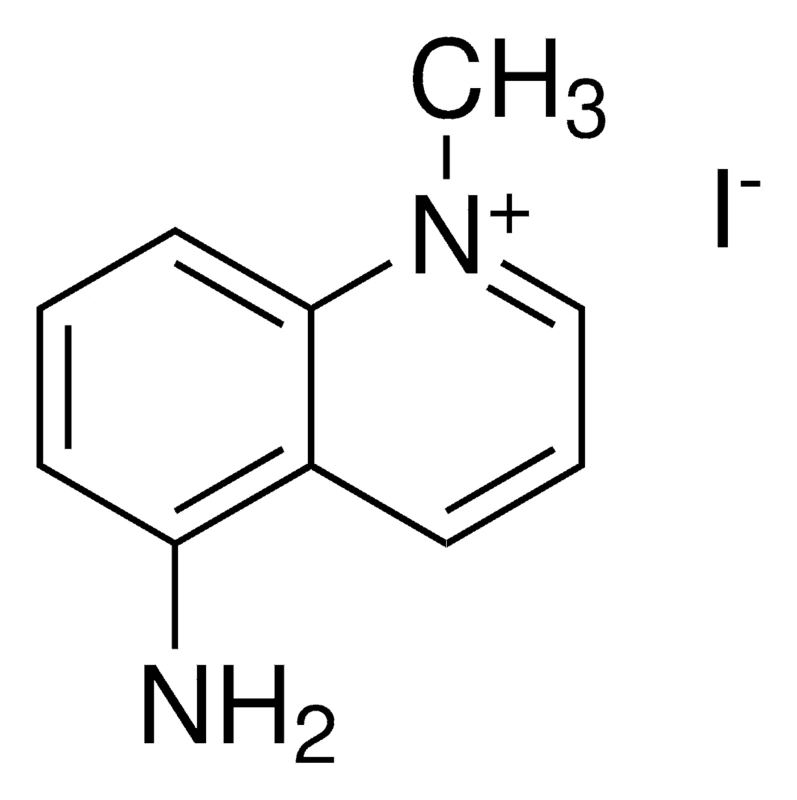
Exists only as a salt (commonly the iodide, CAS 42464-96-0, PubChem CID 66522933) — a brown to reddish-brown powder; the free base (the bare cation, PubChem CID 950107, CAS 685079-15-6) does not exist.
Mechanism of Action
NNMT is a cytosolic enzyme that transfers a methyl group from SAM to nicotinamide, forming 1-methylnicotinamide (1-MNA) and thereby diverting nicotinamide away from the NAD⁺ salvage pathway. 5-Amino-1MQ binds at the NNMT substrate site (IC₅₀ = 1.2 μM), selectively, without affecting related methyltransferases.
NAD⁺ and Sirtuins
Blocking NNMT conserves nicotinamide for NAD⁺ resynthesis. In adipocyte culture, 5-Amino-1MQ raises intracellular NAD⁺ 1.2–1.6-fold (1–60 μM) and lowers 1-MNA by up to 60%. The NAD⁺ rise activates SIRT1 and AMPK — unlike precursors (NMN, NR) that add raw material, this is a conservation mechanism: less nicotinamide is wasted.
Preclinical Data
Neelakantan et al. (2018, Biochem Pharmacol): diet-induced obese mice, 20 mg/kg SC 3x/day, 11 days — significant reductions in body weight, white adipose mass (p<0.01), adipocyte size (p<0.0001), and plasma cholesterol (~30%), with no change in food intake. Dimet-Wiley/Neelakantan (muscle aging, 24-month-old mice, NNMTi 5–10 mg/kg): increased muscle stem cell proliferation and fusion, ~2-fold greater fiber cross-sectional area, and roughly +70% peak tibialis anterior torque versus controls. All data are cell-culture/rodent; no human trials have been published.
Storage
-20°C, airtight container, protect from light and moisture — the salt is hygroscopic.