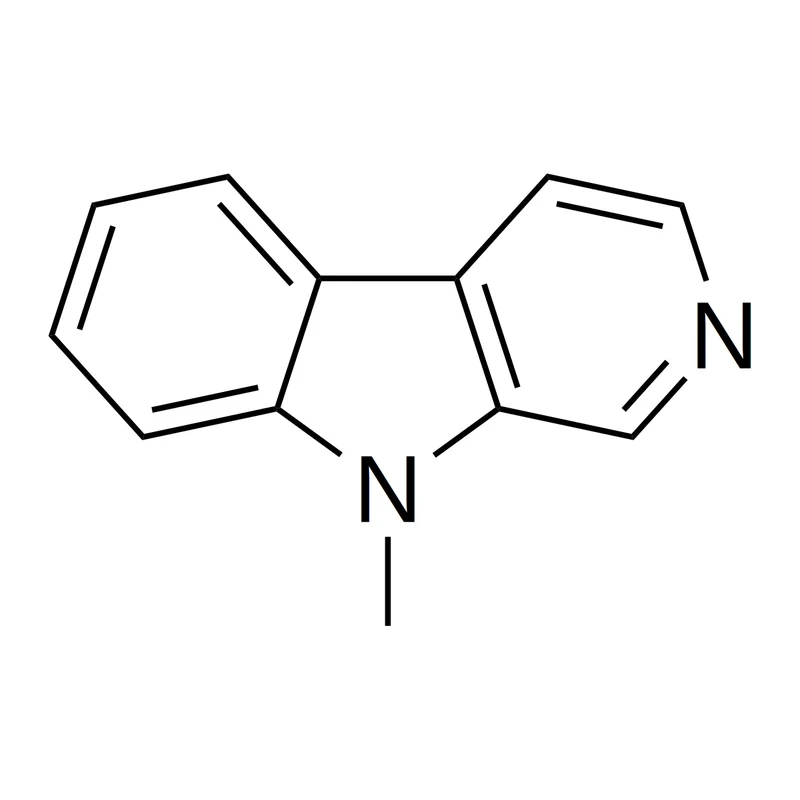
9-Methyl-beta-carboline (9-Me-BC) was discovered by a Dresden group during a large-scale screening of β-carbolines for neurotoxicity. 9-Me-BC showed the opposite effect — stimulation of neurogenesis: it raised ATP, increased differentiation of dopaminergic neurons, stimulated the expression of neurotrophic and transcription factors, and lowered the expression of inflammation-related genes.
Dopamine synthesis stimulation. The principal mechanism is up-regulation of tyrosine hydroxylase (TH), the rate-limiting enzyme of dopamine synthesis. In primary mesencephalic cultures 9-Me-BC doubles the number of TH⁺ neurons. The effect is independent of D2/D3 receptors (sulpiride blockade does not abolish the response) and is mediated by the PI3K cascade. In a J. Neurochem. (2012) study, administration to rats produced a marked rise in hippocampal dopamine alongside proliferation of dendrites and synapses and improved cognitive performance in behavioural tests.
MAO inhibition. A reversible inhibitor of MAO-A (IC₅₀ = 1 µM) and MAO-B (IC₅₀ = 15.5 µM). Reduced dopamine degradation in the synaptic cleft synergises with TH up-regulation: the compound simultaneously increases synthesis and prolongs the transmitter's action.
Neurogenesis and neurite outgrowth. Stimulates differentiation of precursors into mature dopaminergic neurons and increases the density of dendritic branching and synaptic contacts. Via astrocytes it up-regulates BDNF, GDNF (Artn), TGF-β2 and NCAM1. Restores dopaminergic neurons after chronic rotenone exposure in vitro; lowers α-synuclein levels in parkinsonian models.
Anti-inflammatory action. Suppresses microglial proliferation and lowers chemotactic cytokine levels in the CNS.
Photosensitisation. The compound may cause increased sensitivity to UV radiation. Store in dark opaque containers, protect from direct light.
Evidence base
All available research on 9-Me-BC
The first β-carboline with neuroprotective action
Discovery of the compound
Cell culture
· primary mouse mesencephalic culture · Hamann et al. , Neurochemistry International , Germany , 2008 Q2
A screen of β-carbolines for neurotoxicity. 9-Me-BC turned out to be the first member of the class with the opposite profile: it lowered basal lactate dehydrogenase release, reduced the number of propidium iodide-stained cells, decreased caspase-3 activity and raised ATP content while total protein stayed unchanged. The number of differentiated dopaminergic neurons rose significantly, and transcription of Shh, Wnt1, Wnt5a, En1, En2, Nurr1, Pitx3, Th, Dat and Aldh1a1 increased. Expression of inflammation-related genes fell. Dopamine uptake capacity rose; dopamine content rose non-significantly. An anti-proliferative effect was seen in SH-SY5Y neuroblastoma.
Cell culture
· primary mouse dopaminergic culture · Polanski et al. , Journal of Neurochemistry , Germany , 2010 Q1
TH expression rose in pre-existing DOPA decarboxylase-positive neurons together with the transcription factors Gata2, Gata3, Creb1 and Crebbp, and neurite outgrowth increased. The compound protected cultures against 2,9-dimethyl-β-carbolinium toxicity and restored neurons after chronic rotenone exposure. The anti-inflammatory component was suppression of activated microglial proliferation and reduced expression of inflammatory cytokine and receptor genes. α-Synuclein protein fell despite increased expression of its gene, which the authors attribute to faster protein turnover. Blocking the dopamine transporter abolished the gain in neuron number but further increased neurite outgrowth.
Dopamine restoration in a parkinsonian model
Respiratory chain complex I +80%
Rats
· rats after 28 days of MPP⁺ · Wernicke et al. , Pharmacological Reports , Germany / Poland , 2010
Animals received the neurotoxin MPP⁺ for 28 days at a dose that lowered dopamine by roughly 50%. 9-Me-BC was then delivered into the left cerebral ventricle for 14 days. It reversed the dopamine loss in the left striatum, and stereological counts of TH-immunoreactive cells in the substantia nigra returned to normal values. Complex I activity in striatal mitochondria was about 80% higher than in the MPP⁺ plus saline group and in sham-operated animals. GDNF and BDNF expression increased.
Improved spatial learning
10-day course works, 5-day course does not
Rats
· female Wistar rats, radial maze · Gruss et al. , Journal of Neurochemistry , Germany , 2012 Q1
Ten days of treatment improved spatial learning in the radial maze, raised dopamine levels in the hippocampal formation, and produced longer, more complex dendritic trees with more spines on dentate gyrus granule neurons. A five-day course produced none of these effects — the result depends on duration, not dose alone.
MAO inhibition and the role of astrocytes
IC₅₀ 1 µM for MAO-A
Cell culture
· mouse mesencephalic and cortical cultures · Keller et al. , Journal of Neural Transmission , Germany , 2020
IC₅₀ was 1 µM for MAO-A and 15.5 µM for MAO-B (rasagiline, for comparison, gives 412 nM and 4.43 nM). The maximum gain in TH-positive neurons was 33 ± 8% at 90 µM; at 70 µM the 27 ± 7% gain was unaffected by sulpiride, so D2/D3 receptors are not involved. The PI3K inhibitor LY294002 abolished the effect completely. In cortical astrocytes, 90 µM raised Artn expression 3.2-fold, Bdnf twofold, Ntf3 1.8-fold, Skp1 1.5-fold, and Tgfb2 and Ncam1 1.4-fold. There was no toxicity: viability rose 12% at 90 µM and 20% at 150 µM, and LDH release fell to 73% of control. Astrocyte proliferation was instead suppressed — BrdU incorporation dropped by 39 ± 4% at 90 µM and 71 ± 6% at 150 µM.
For research use only. This product is not a medicine, food supplement or cosmetic. Not intended for human or animal use. Sold to persons aged 18+.