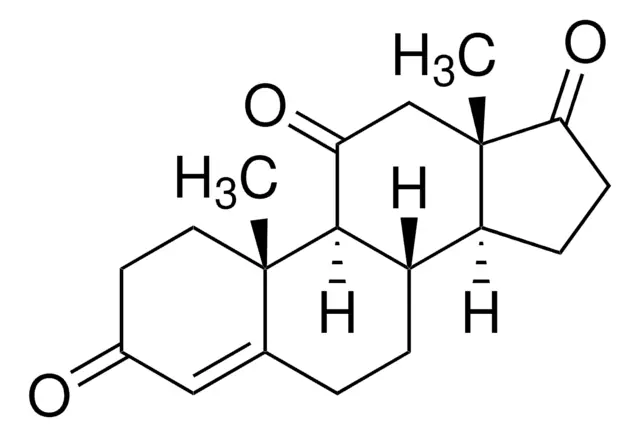
Adrenosterone (11-OXO, 11-ketoandrostenedione) is an endogenous steroid hormone naturally produced in the adrenal cortex. It belongs to the androstane class and is structurally androst-4-ene-3,11,17-trione, bearing three ketone groups.
Mechanism of Action
The primary documented mechanism is competitive inhibition of 11β-hydroxysteroid dehydrogenase type 1 (11β-HSD1, IC₅₀ ~1–2 μM). This enzyme catalyzes the intracellular reduction of inactive cortisone to active cortisol in the liver, adipose tissue, and other peripheral tissues. By blocking this pathway, adrenosterone reduces local cortisol concentrations without significantly affecting HPA axis function or circulating cortisol levels.
Additionally, adrenosterone acts as a prohormone of 11-ketotestosterone (11-KT): via 17β-HSD it is converted to 11-KT, an active androgen that binds the androgen receptor with weak potency relative to testosterone. The intrinsic androgenic activity of adrenosterone itself is minimal.
Pharmacokinetics
Oral bioavailability is limited due to extensive first-pass metabolism; T½ ~1–2 hours. Major urinary metabolites include 11β-hydroxyandrosterone, 11β-hydroxyetiocholanolone, 11-oxoandrosterone, and 11-oxoetiocholanolone. Detectable by standard anti-doping methods (GC-MS / GC-C-IRMS).
Physicochemical Properties
Molecular weight: 300.39 g/mol. Appearance: white to off-white crystalline powder. Melting point: 219–222 °C. Optical rotation: [α]²⁰/D +300° (c = 1, chloroform). Lipophilic compound; readily soluble in organic solvents (acetone, DMSO, chloroform, ethyl acetate), practically insoluble in water.
Storage
Powder is stable for 3–5 years at room temperature (+15 °C…+25 °C) in an airtight container protected from light and moisture. Storage at +4 °C extends shelf life further. DMSO solutions should be aliquoted and stored at −20 °C for up to 12 months.