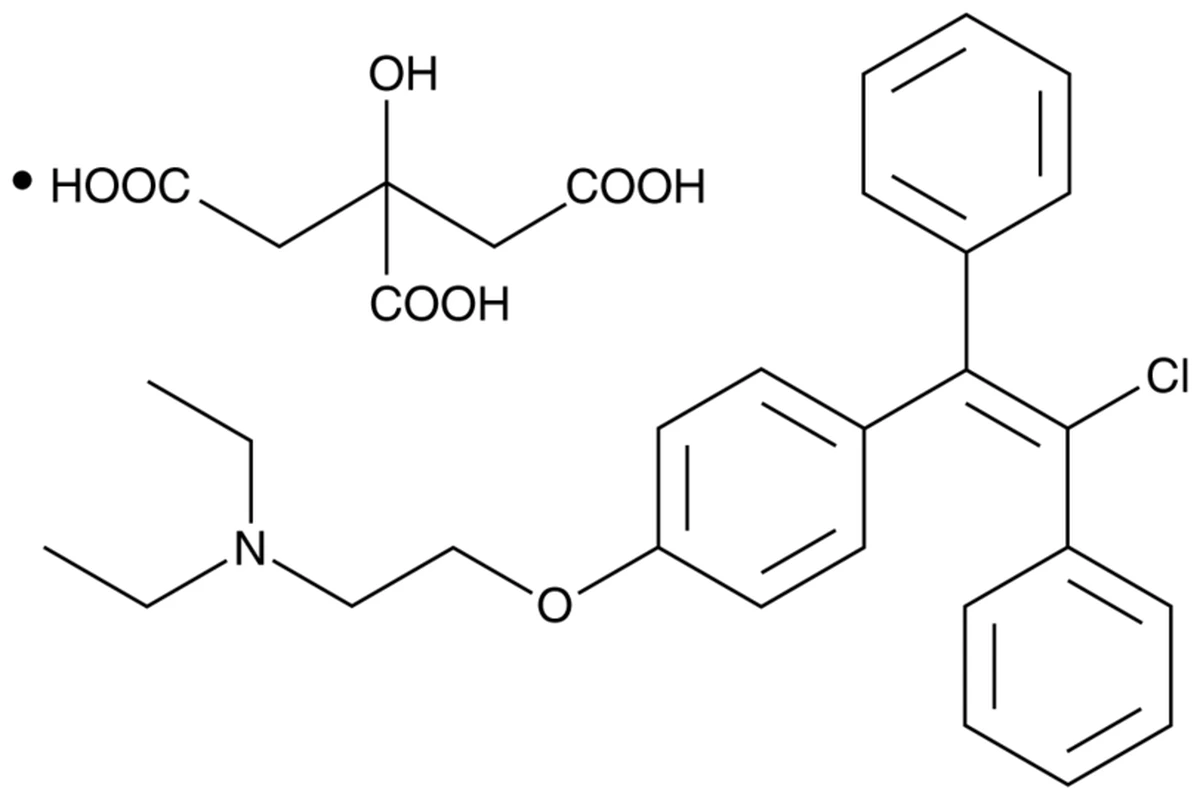
Enclomiphene Citrate (ICI-46476, RMI-16289, Androxal, Enclomid) is the trans-isomer of clomiphene, a selective estrogen receptor modulator (SERM). Unlike racemic clomiphene citrate (50:50 cis/trans mixture), enclomiphene is the pure (E)-isomer responsible for the primary antiestrogenic and gonadotropin-stimulating activity of the molecule.
Mechanism of Action
Enclomiphene binds estrogen receptors (ER) in the hypothalamus and pituitary gland as an antagonist. Normally, estrogen suppresses GnRH secretion via negative feedback. By blocking ER, enclomiphene removes this inhibition:
→ ↑ GnRH from the hypothalamus
→ ↑ LH and FSH from the pituitary
→ ↑ testosterone from Leydig cells in the testes
→ ↑ FSH maintains spermatogenesis in Sertoli cells
Binds ERα with IC₅₀ ~1–2 µM in vitro.
Clinical Data
In hypogonadal men, daily dosing of 12.5–25 mg for 3 months elevated testosterone from ~250 ng/dL to >600 ng/dL while simultaneously raising LH and FSH. Sperm concentration was preserved or increased — in contrast to exogenous testosterone, which suppresses the HPG axis and leads to azoospermia.
Key Difference from the Racemic Mixture
The cis-isomer (zuclomiphene) in racemic clomiphene has a long T½ (~30 days) and accumulates in tissues with prolonged use. As a single isomer, enclomiphene lacks this drawback: T½ is approximately 10 hours and concentrations stabilize and clear rapidly after discontinuation.
Visual Side Effects
Zuclomiphene is an ER agonist/partial agonist in the retina and visual pathway — it is the accumulation of this cis-isomer that causes the visual disturbances associated with racemic clomiphene: blurred vision, photophobia, floaters, and in rare cases optic neuropathy or color perception changes. Because enclomiphene contains no zuclomiphene, this risk is substantially lower: in the Kim (2014) trial, visual complaints fell from ~5% on clomiphene to under 1% on enclomiphene. A class-level risk (as any SERM binding retinal ER) is not entirely absent, but is significantly reduced.
Species Specificity
Enclomiphene is an ER antagonist in humans, sheep, and rabbits. In rats it acts as an ER agonist — a standard caveat for cross-species data translation.
Physicochemical Properties
Molecular weight: 598.08 g/mol. Appearance: white to off-white powder. Melting point: ~147–150°C (DSC). Soluble in DMSO (~30–50 mg/mL), ethanol, and methanol. Aqueous solubility is limited — the citrate salt is more soluble than the free base (particularly at pH 4.5), but not freely water-soluble. The purpose of the citrate form is improved solubility relative to the free base, better oral bioavailability, and enhanced stability.
Storage
Room temperature (15–25°C), dark, dry place, airtight container. Stable ≥24 months under proper conditions. Freezing is not required.