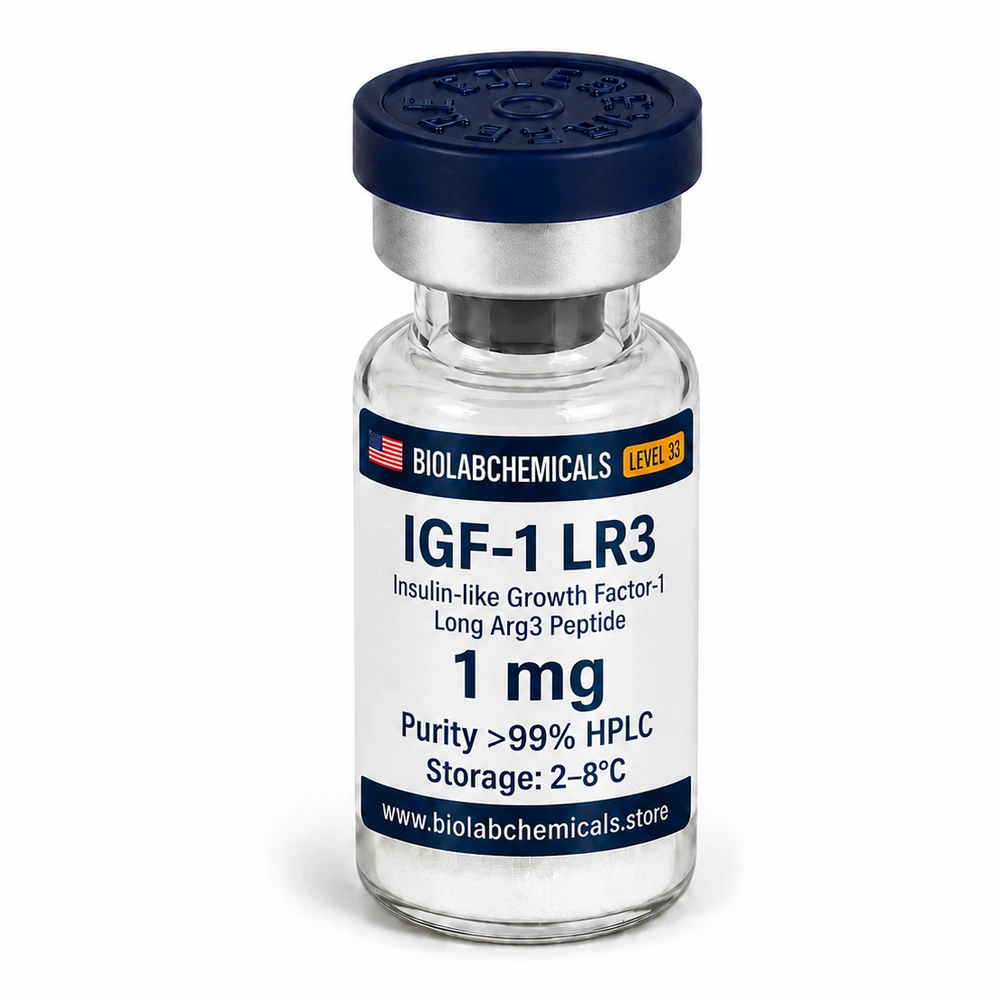
IGF-1 LR3 (Long R3 IGF-1) is an injectable synthetic 83-amino-acid analogue of insulin-like growth factor 1. It differs from native IGF-1 (70 amino acids) by two changes: an extra 13-amino-acid extension at the N-terminus ("Long") and substitution of glutamic acid with arginine at position 3 ("R3"). The molecule carries three internal disulfide bridges characteristic of the insulin superfamily.
Mechanism of Action
IGF-1 LR3 activates the IGF-1 receptor (IGF-1R), triggering the intracellular PI3K/Akt and MAPK/ERK cascades that stimulate cell growth, division and differentiation, protein synthesis, and suppress apoptosis. The key advantage of the LR3 form: the position-3 substitution sharply reduces (roughly 100-fold) binding to IGF binding proteins (IGFBPs), which normally sequester most IGF-1 and render it inactive; so more active compound reaches the tissues, the half-life is longer (about 20–30 h versus 12–15 h for native IGF-1), and it is roughly three times more potent. In muscle, IGF-1 LR3 acts in two directions at once: through the Akt → mTORC1 → p70S6K/4E-BP1 axis it boosts protein synthesis (ribosomes and translation), while by suppressing FoxO transcription factors it switches off the muscle-atrophy genes — the atrogenes MuRF1 and MAFbx (atrogin-1) — reducing protein breakdown. Together this produces a strong anabolic and anti-catabolic effect. In addition, the peptide has an insulin-like action — it lowers blood glucose (hence a risk of hypoglycemia at high doses).
Effects in Research
Thanks to its strong anabolic action, IGF-1 LR3 is widely used as a growth factor in cell research — for culturing and expanding cells (stem cells, neurons, and muscle, bone and cartilage cells; it classically stimulates proliferation of NIH 3T3 and C2C12 lines) and for protecting cells from oxidative stress and apoptosis. It is studied in the context of muscle growth and recovery (myoblast proliferation, hypertrophy, counteracting atrophy); angiogenesis and wound healing (anti-inflammatory action via Ras/PI3K/NF-κB); metabolism (insulin-like glucose lowering and effects on insulin secretion — hence interest in diabetes research); reproduction (follicle development and ovulation); and organ growth in fetal-development models. A distinct new direction is neuroprotection: intranasal LR3 IGF-1 in mice with an Alzheimer's model (5xFAD) affected beta-amyloid plaques and showed that the peptide reaches the brain by a non-invasive route.
Properties
White lyophilized powder, soluble in water (including bacteriostatic water). Sequence (83 aa): MFPAMPLSSLFVNGPRTLCGAELVDALQFVCGDRGFYFNKPTGYGSSSRRAPQTGIVDECCFRSCDLRRLEMYCAPLKPAKSA. Formula C₄₀₀H₆₂₅N₁₁₁O₁₁₅S₉, molecular weight ≈9111.5 Da. CAS 946870-92-4.
Storage
Store the lyophilized powder at 2–8°C in a dry place protected from light; for long-term storage −20°C is optimal. After reconstitution keep refrigerated, do not freeze, and use within a few weeks.
 BIOLABCHEMICALS