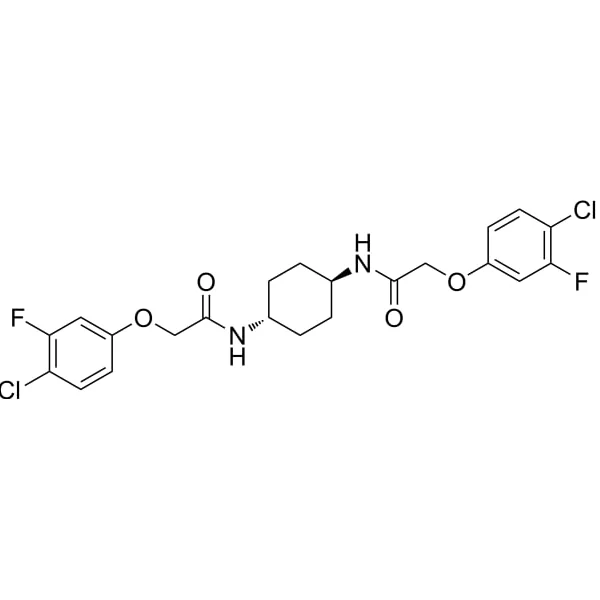
trans-ISRIB-A17 powder
trans-ISRIB-A17 · ISRIB-A17 · ISRIB A17 · ISRIB A-17 · ІСРІБ-А17 · ИСРИБ-А17 · ISR-IN-1 · Compound 48 · trans-isrib A17 · фторований аналог ISRIB · ISRIB analog
trans-ISRIB-A17 is not a different molecule but an improved version of trans-ISRIB. The structural difference is minimal: a single fluorine atom is added at position 3 of each of the two chlorophenoxy rings. Everything else is the same bis-O-arylglycolamide scaffold and the same trans configuration of the cyclohexane ring on which activity depends.
This single edit delivers two practical gains. Potency increased roughly tenfold: EC₅₀ is 0.6 nM versus 5 nM for the parent trans-ISRIB (ChemicalBook). And solubility increased by more than an order of magnitude: 12.5 mg/mL in DMSO versus 1 mg/mL for trans-ISRIB (MedChemExpress). It is precisely the introduction of a halogen — fluorine or chlorine — into the ISRIB molecule that raises its aqueous solubility (NutraBiotech).
Poor solubility was the main practical limitation of the parent ISRIB: the molecule required careful vehicle selection. A17 removes that constraint from two directions at once. Solutions are easier to prepare, since 12.5 times more compound dissolves in the same volume of DMSO. And less compound is needed: with tenfold higher potency, an activity-equivalent amount is roughly ten times smaller — about 100 mg of A17 corresponds to roughly 1 g of the parent ISRIB.
The compound comes from the systematic structure-activity study carried out by the Hearn team in 2016, which screened a series of bis-O-arylglycolamides and identified analogues more potent than the parent ISRIB. In that work A17 appears as Compound 48, hence its second designation — ISR-IN-1 (ChemMedChem, 2016).
The mechanism is identical to trans-ISRIB. The molecule does not block eIF2α phosphorylation by upstream kinases but acts downstream: it activates the guanine nucleotide exchange activity of eIF2B, restoring the cell's capacity for full protein synthesis even in the presence of phosphorylated eIF2. Cryo-electron microscopy showed the binding site lies at the interface between the β and δ regulatory subunits of dimeric eIF2B — the molecule effectively staples two symmetric protein interfaces together (eLife, 2018).
Because the target and mechanism are identical, the entire accumulated body of integrated stress response research applies to A17: enhancement of spatial and fear-associated memory in healthy rodents (eLife, 2013), restoration of cognition after traumatic brain injury even four weeks post-injury (PNAS, 2017), rapid return of aged mice to youthful cognitive performance (eLife, 2020), and recovery of long-term memory in a Down syndrome model (Science, 2019).
Differences at a glance. Formula C₂₂H₂₂Cl₂F₂N₂O₄ versus C₂₂H₂₄Cl₂N₂O₄, molecular weight 487.32 versus 451.34, EC₅₀ 0.6 nM versus 5 nM, DMSO solubility 12.5 mg/mL versus 1 mg/mL. Scaffold, target and mechanism are shared (ChemicalBook).
Supplied as a crystalline powder, purity ≥98% (HPLC), CAS 1628478-15-8. The parent molecule for comparison is trans-ISRIB.