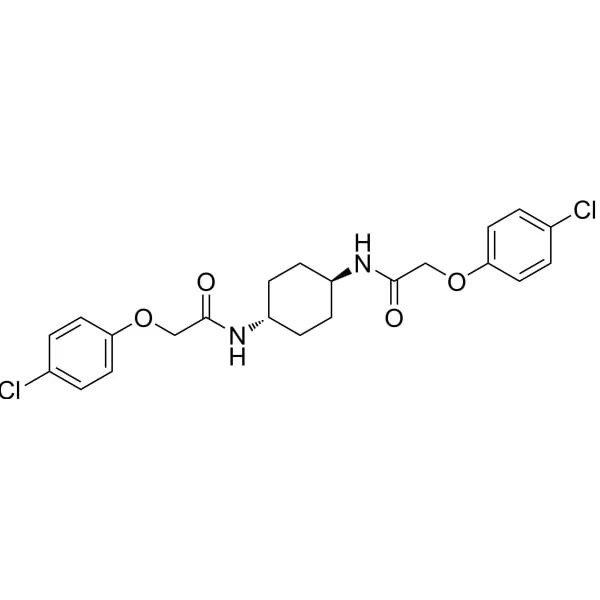
ISRIB powder (trans-ISRIB)
ISRIB · trans-ISRIB · ІСРІБ · ИСРИБ · ІСРИБ · ISRIB trans-isomer · Integrated Stress Response Inhibitor · інгібітор інтегрованої стресової відповіді
Biological activity resides specifically in the trans-isomer. According to supplier data, trans-ISRIB is roughly 100-fold more potent than the cis form: IC₅₀ 5 nM versus 600 nM, indicating a stereospecific interaction with its target (MedChemExpress). This listing is trans-ISRIB — the active trans form, CAS 1597403-47-8, purity ≥98% by HPLC.
ISRIB (Integrated Stress Response Inhibitor) is a synthetic symmetric bis-glycolamide discovered in 2013 in Peter Walter's laboratory at the University of California, San Francisco (eLife, 2013). It restores cellular protein synthesis after it has been throttled by the integrated stress response (ISR), a universal quality-control mechanism triggered by various forms of cellular stress.
The mechanism is precise and elegant: ISRIB does not block eIF2α phosphorylation by upstream kinases but acts downstream — stabilising the eIF2B factor and thereby restoring translation (eLife, 2015). A notable detail: in unstressed cells ISRIB induces no major changes in either translation or mRNA levels, meaning it acts selectively precisely where the ISR is active.
Memory in healthy animals. Already in the original 2013 study, mice treated with ISRIB showed significant enhancement in spatial learning and in fear-associated memory tests. This pointed to a role for eIF2α phosphorylation in modulating higher-order brain function (eLife, 2013).
Cognitive recovery after traumatic brain injury. In two independent TBI models, ISRIB fully restored the learning capacity of mice — even when dosing began four weeks after the injury, with the improvement persisting for a week after treatment ended (PNAS, 2017). In hippocampal slices, ISRIB restored long-term potentiation (LTP), the cellular basis of new memory formation. Researchers described the result as a paradigm shift: such deficits had previously been considered irreversible.
Age-related cognitive decline. In aged mice, ISRIB rapidly restored cognitive performance to youthful levels, accompanied by rejuvenation of neurons and brain immune cells. The improvement persisted for weeks after dosing ended, with no side effects observed in the study (eLife, 2020). The authors emphasised that a substantial part of age-related loss proved to be a reversible physiological "blockage" rather than permanent degradation.
Down syndrome. In a mouse model, ISR activation proved to be a key link in long-term memory deficits, and correcting the ISR with ISRIB restored hippocampal protein synthesis and the animals' cognitive performance (Science, 2019).
Other research directions. ISRIB has been shown to potently attenuate β-amyloid-induced neuronal cell death at 12.5–25 nM without affecting amyloid production itself, and to suppress ER stress-induced inflammatory gene expression (BioVision). In cell culture, trans-ISRIB is used at 0.7 µM to enhance survival of human pluripotent stem cells during passaging (Captivate Bio).
Pharmacokinetics. ISRIB readily crosses the blood-brain barrier and has a plasma half-life of approximately 8 hours (Wikipedia). It is this combination of high potency, brain penetration and selectivity that has made the molecule one of the most discussed in contemporary neuroscience: rights were licensed to Calico, and development has advanced to clinical studies together with AbbVie.
Supplied as a crystalline powder, purity ≥98% (HPLC). Store at +2…8 °C in a dry place protected from light. A fluorinated analogue also exists — trans-ISRIB-A17, roughly tenfold more potent and considerably more soluble.