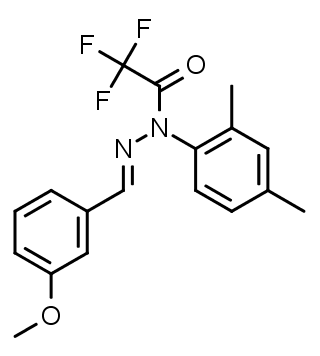
J-147 is a synthetic hydrazide (N-(2,4-dimethylphenyl)-2,2,2-trifluoro-N′-[(E)-(3-methoxyphenyl)methylene]acetohydrazide) developed at the Schubert laboratory (Salk Institute) via phenotypic screening for anti-aging activity in primary neuronal cultures. Despite the original 'curcumin derivative' framing, the compound is structurally unrelated to curcumin.
Molecular Target
Identified in 2018 (Cell Metabolism): J-147 binds to the α-subunit of mitochondrial ATP synthase (ATP5A). This elevates mitochondrial membrane potential and activates TRPC3/6 channels, increasing intracellular Ca²⁺ and subsequently activating BDNF/NGF signaling. The compound also modulates AMPK/mTOR pathways and inhibits MAO.
Preclinical Data
APP/PS1 transgenic mice (AD model): significant improvement in spatial memory and learning, reduced soluble Aβ40/42 levels, decreased oxidative stress and inflammatory markers. SAMP8 mice (accelerated aging model): enhanced spatial memory, elevated hippocampal BDNF and NGF. In vitro in primary cortical neurons: protection against glutamate- and Aβ-induced toxicity at EC₅₀ ≈ 25–200 nM; LTP potentiation.
Pharmacokinetics
High oral bioavailability, good BBB penetration — unlike curcumin. Soluble in DMSO (≥70 mg/mL). Stable at room temperature protected from light.