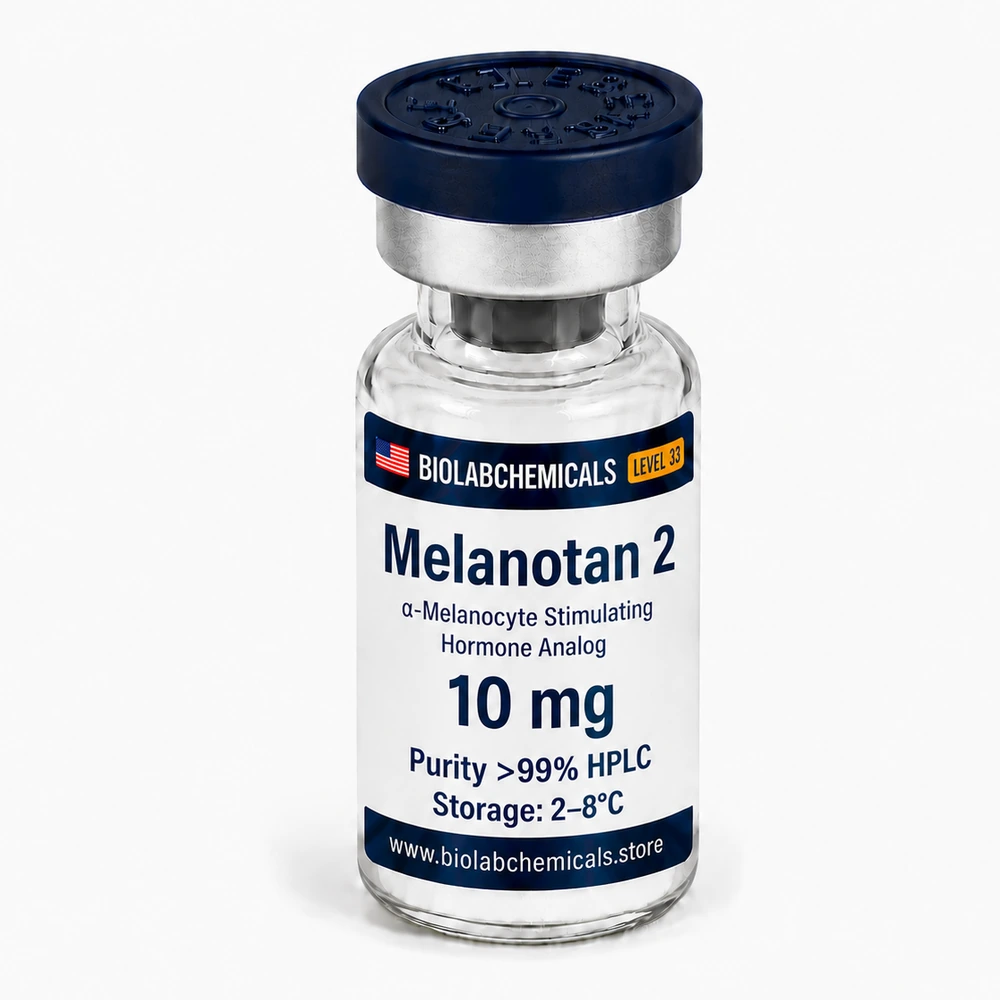
Melanotan 2 (MT-II) is a synthetic cyclic heptapeptide, an analogue of α-melanocyte-stimulating hormone (α-MSH), developed at the University of Arizona. Compared with natural α-MSH it was made more compact and stable: replacing methionine with norleucine (Nle) protects against oxidation, D-phenylalanine protects against enzymes, and a lactam bridge closes the chain into a ring. As a result MT-II is more potent and longer-acting than the natural hormone.
Mechanism of Action
MT-II is a non-selective melanocortin receptor agonist: it activates MC1R, MC3R, MC4R and MC5R (Ki ≈0.67, 34, 6.6 and 46 nM respectively; it has almost no affinity for MC2R). Each subtype drives a different effect. MC1R on melanocytes boosts production of the pigment melanin — hence skin darkening (tanning) even with minimal UV. MC4R in the central nervous system affects sexual function (stimulating erection, raising libido), reduces appetite and at the same time increases energy expenditure (MC4R mutations are the most common monogenic cause of obesity). MC5R governs sebaceous-gland secretion and is involved in skin repair. Through MC1R/MC3R, melanocortins have anti-inflammatory activity (inhibiting NF-κB translocation). An important point about duration: the peptide itself has a short half-life, but the effects differ — pigmentation lasts weeks to months (melanin remains in skin cells until they are naturally shed), whereas the effects on libido and appetite are short-lived.
Effects in Research
The main area is melanogenesis: MT-II is used as a tool to study skin pigmentation and photoprotection (a related linear analogue — afamelanotide, i.e. Melanotan 1 — is already approved for a rare photosensitivity disorder). The second is sexual function: MT-II underwent early clinical trials for erectile dysfunction, and its derivative bremelanotide (PT-141) was later approved to treat hypoactive sexual desire. Through MC4R, its effect on appetite, body weight and fat burning is studied (rodent studies report marked reduction of fat tissue). Separate directions are neuroprotection and nerve regeneration (dose-dependent improvement of recovery after sciatic-nerve injury and protection against cisplatin neuropathy; Ter Laak et al., 2003) and the anti-inflammatory, immunomodulatory action of melanocortins.
Other Research Directions
Beyond tanning, sexual function and appetite, melanotan 2 is studied in a number of other preclinical (mostly animal) models; the findings below are isolated and preliminary. Oncology: in the B16-F10 melanoma model, MT-II did not affect proliferation of tumor cells but inhibited their migration, invasion and colony formation — via upregulation of the tumor-suppressor PTEN (MC1R pathway) and inhibition of the COX-2/PGE2 cascade. Neurodevelopment and behavior: in a mouse model of maternal-immune-activation autism, MC4R agonism improved social behavior; in another study melanotan reversed memory impairment and anxiety after a short high-fat diet. Social behavior: MT-II influenced it through the oxytocin system (neurons of the supraoptic and paraventricular hypothalamic nuclei). Metabolism and thermoregulation: effects on brown-fat thermogenesis (a PACAP axis) and on body temperature via the histamine system and mast cells have been described.
Properties
White to off-white lyophilized powder, soluble in water (≈5 mg/mL). Sequence: Ac-Nle-cyclo[Asp-His-D-Phe-Arg-Trp-Lys]-NH₂. Formula C₅₀H₆₉N₁₅O₉, molecular weight ≈1024.2 Da. CAS 121062-08-6, PubChem CID 92432. Synonym — MT-II.
Storage
Store the lyophilized powder at 2–8°C in a dry place protected from light; for long-term storage −20°C is optimal. After reconstitution keep refrigerated, do not freeze, and use within a few weeks.
 BIOLABCHEMICALS