Message the manager to join our researchers' chat
Ask a question manager online
UK RU EN
Мова
UK RU EN
Валюта
Shopping Cart
Catalog /Research Chemicals /MTEP hydrochloride powder
Very Rare
In Stock
MTEP hydrochloride powder

MTEP hydrochloride powder

MTEP · MTEP HCl · MTEP hydrochloride · МТЕР · МТЭР · МТЕП · MTEP·HCl · mGluR5 antagonist · антагоніст mGluR5 · негативний алостеричний модулятор mGlu5

Purity ≥98% HPLC · PASS
Specification
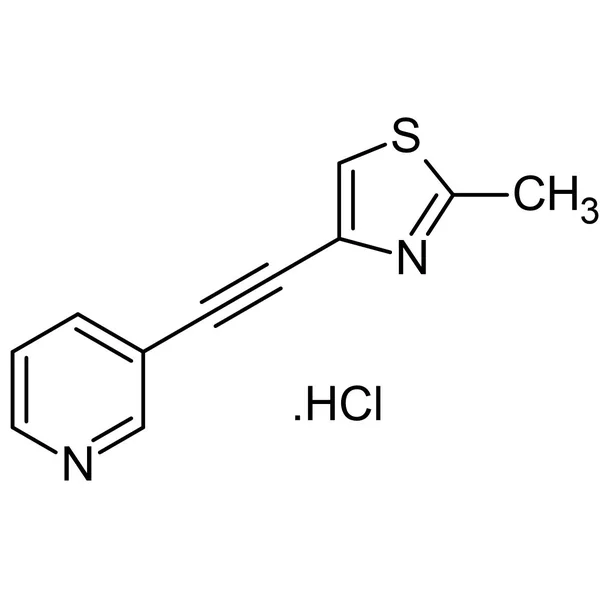
IUPAC3-[(2-Methyl-1,3-thiazol-4-yl)ethynyl]pyridine hydrochloride
CAS1186195-60-7
FormulaC₁₁H₉ClN₂S
Mol. weight236.72 г/моль
Purity≥98% · HPLC
Formpowder
Storage+4 °C; 12 months
Place an order
$130.00
1
● In stock · we ship tomorrow before 17:00
Purity ≥98%, verified by HPLC
CoA for every lot
Nova Poshta, 1–2 days in Ukraine
Payment by card or USDT
Compound description

What is MTEP hydrochloride powder

MTEP is a selective negative allosteric modulator of metabotropic glutamate receptor subtype 5 (mGluR5), developed by Merck (Wikipedia). We supply it as the hydrochloride, CAS 1186195-60-7 — the stable crystalline salt in which Tocris, Abcam and other research suppliers sell the compound.

Potency and mechanism. MTEP inhibits mGluR5 with an IC₅₀ of 5 nM in a calcium-flux assay and a Ki of 16 nM (Tocris). It acts non-competitively: binding to an allosteric site, it modulates glutamatergic transmission without competing with glutamate at the orthosteric site. In practice this means reduced excessive excitatory transmission, regulated intracellular calcium mobilisation, and effects on synaptic plasticity cascades (MedKoo).

The main advantage is over MPEP. MTEP was designed specifically as an improvement on the previous standard in this class. It shows fivefold more potent anxiolytic activity than MPEP and, more importantly, is devoid of the side effects seen with MPEP and benzodiazepines (Abcam). This is why MTEP displaced MPEP as the reference mGluR5 antagonist in neuroscience.

Selectivity. The figures speak clearly: IC₅₀ at MAO-A is 30 µM, at mGlu1, mGlu2 and mGlu7 above 100 µM, and at NR2B above 300 µM (Sigma-Aldrich). That is a separation of six thousand to sixty thousandfold from the target receptor. The compound does not affect mGluR2, mGluR7, NMDA, AMPA or kainate receptors (GlpBio).

Anxiolytic activity in vivo. In rodents the effective dose is an ED₅₀ of 1 mg/kg intraperitoneally and 7 mg/kg orally (Sigma-Aldrich). A separate study showed that MTEP's anxiolytic effect does not involve GABA-A signalling (Klodzinska et al., Neuropharmacology 2004) — a mechanism fundamentally different from that of benzodiazepines.

Oral activity and brain penetration. The compound is orally active and freely crosses the blood-brain barrier (Abcam). For an allosteric modulator this is a non-trivial combination, and it is precisely what made MTEP a working tool for behavioural studies rather than cellular work alone.

Antidepressant and neuroprotective activity. In vivo MTEP shows antidepressant-like activity (Abcam), and separate work demonstrated neuroprotective potential against kainate-induced excitotoxicity in the rat hippocampus (MedKoo).

Antiparkinsonian effect. At doses of 0.5–3 mg/kg MTEP reduced haloperidol-induced muscle rigidity in rats, measured as hind-limb resistance (Ossowska et al., GlpBio). This is one of the few directions in which mGluR5 antagonism produced a reproducible motor outcome.

Fields of application. The compound is used in preclinical research on anxiety, depression, schizophrenia, Parkinson's and Alzheimer's disease, addiction, pain and synaptic plasticity (MedKoo). The original characterisation was published in J Med Chem (Cosford et al., 2003).

Important for calculations. The molecular weight of the hydrochloride is 236.72 versus 200.26 for the free base. Calculate weighed amounts using the salt.

Supplied as a crystalline powder, CAS 1186195-60-7.

For research use only. This product is not a medicine, food supplement or cosmetic. Not intended for human or animal use. Sold to persons aged 18+.