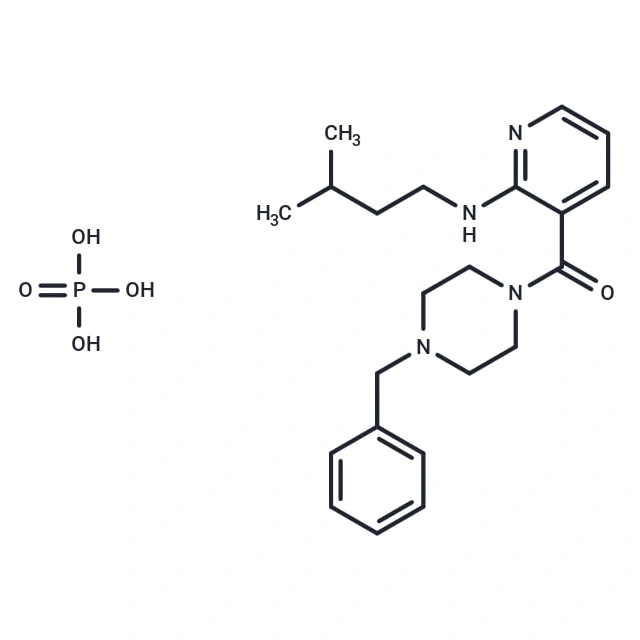
NSI-189 phosphate powder
NSI-189 phosphate · Amdiglurax (INN) · ALTO-100 · NSI-189 (free base) · NeuralStem Inc. 189 · CS-1018 · 3-(4-Benzylpiperazine-1-carbonyl)-N-(3-methylbutyl)pyridin-2-amine phosphate
NSI-189 phosphate price
Solubility NSI-189 phosphate
- NSI-189 phosphate (CAS 1270138-41-4): water solubility — about 0.13 mg/mL; DMSO solubility — up to 25–65 mg/mL (MedChemExpress).
Storage conditions NSI-189 phosphate
A stable compound — no special short-term storage conditions required
+4 °C — up to 2 years
−20 °C — up to 5 years
Protection from moisture and light extends shelf life
After the freezer, let it reach room temperature before opening
Legal status and regulatory restrictions NSI-189 phosphate
- Under investigation in Phase II clinical trials for depression, but not yet registered as a medicine
- Not approved by the FDA or other national regulators
- Cannot be registered or sold as a supplement for human consumption
- The only lawful form of circulation is a research tool compound, not for human consumption or therapeutic use
Where to buy NSI-189 phosphate?
What is NSI-189 phosphate?
NSI-189 phosphate is a first-in-class neurogenic small molecule described as a hippocampal neurogenesis stimulant and activator of BDNF neurotrophic signaling.
The compound was discovered at Neuralstem through a large-scale screen of a 10,269-compound library — selected specifically for the ability to enhance neurogenesis. Early development was supported by DARPA and the US National Institutes of Health (NIH). Pharmacokinetics: peak concentration at 1–2 h, elimination half-life 17.4–20.5 h.
NSI-189 acts through neurotrophic pathways: it raises BDNF and stem cell factor (SCF) levels, as well as GDNF and VEGF, and enhances TrkB receptor signaling. In culture it stimulated neurogenesis of human hippocampal neural stem cells, and in animals it dose-dependently increased hippocampal volume — per Neuralstem, roughly +36% at 10 mg/kg and +66% at 30 mg/kg.
A rare advantage for a research compound: NSI-189 has gone through several human clinical trials (phases 1, 1b, 2, 2a and 2b) — over 800 participants combined. It was well tolerated across all of them, with no serious adverse events.
In phase 2a (an open-label study, 2023) the compound showed positive results across two indications at once. In depression, the group selected by a cognitive biomarker (n=59) showed a MADRS reduction of 15.5 points versus 10.6 in the group without the biomarker (p=0.001, d=0.6), with a responder rate of 61% versus 33%. In PTSD (n=44), the CAPS-5 reduction was 17.5 points versus 12.9 (p=0.04). Phase 2 in depression recorded statistically significant cognitive improvements at 40 mg/day: memory (effect size d≈1.12), working memory (d≈0.81) and executive function (d≈0.66).
The molecule is currently being studied in phase 2b for bipolar depression — a trial supported by an $11.7 million grant from the Wellcome Trust, one of the world's largest charitable funders of medical research.
A broad preclinical profile has made NSI-189 a popular tool in neuroscience research. Positive results have been obtained in models of stroke, diabetic neuropathy (types 1 and 2), radiation brain injury, Angelman syndrome, and mitochondrial dysfunction — with restored neurogenesis, synaptic markers, memory, and reduced neuroinflammation. The increase in hippocampal volume first reported by Neuralstem was later independently confirmed by the Allen group (2018) in the peer-reviewed journal Radiation Research. The compound has also been explored for Alzheimer's disease, brain injury, cognition disorders and neurodegeneration.
NSI-189 is used as a research compound for studying hippocampal neurogenesis, BDNF/TrkB signaling, neuroplasticity, and neuroprotection.
Mechanism of action and research NSI-189 phosphate
Went through human clinical trials: well tolerated with cognitive improvements
Clinically studied · well toleratedUnlike most research compounds, NSI-189 has gone through several human clinical trials — over 800 participants in total. It was well tolerated across all of them, with no serious adverse events (most commonly mild headache or nausea, comparable to placebo). Phase 2 (Papakostas, 2020) recorded statistically significant cognitive improvements at 40 mg/day: memory d≈1.12, working memory d≈0.81, executive function d≈0.66. The molecule continues to be studied in phase 2b for bipolar depression, supported by an $11.7 million Wellcome Trust grant; results are expected in 2026.
Stroke: durable recovery of motor and neurological function
Positive resultOral NSI-189 started 6 h after stroke reduced motor and neurological deficits, with benefits sustained to 24 weeks. Histology showed enhanced neurite outgrowth. In culture, NSI-189 protected hippocampal cells from death and raised BDNF and SCF levels — key support for the neurotrophic mechanism.
Protection of cognition and neurogenesis after brain irradiation
Positive resultIn a model of the side effects of brain-tumor radiotherapy, oral NSI-189 significantly restored hippocampal neurogenesis, reduced neuroinflammation (activated microglia by 56%) and improved cognitive performance in behavioral tests.
Angelman syndrome: synaptic plasticity and motor/cognitive function
Positive resultIn a genetic model of Angelman syndrome NSI-189 enhanced synaptic plasticity and reversed impairments in motor and cognitive function, boosting TrkB signalling.
Diabetic neuropathy: protection of both peripheral nerves and the CNS
Positive resultOral NSI-189 in type 1 and type 2 diabetic mice prevented many indices of peripheral neuropathy, increased hippocampal neurogenesis, synaptic markers and hippocampal volume, and protected long-term memory; it also halted progression of established neuropathy.
Mitochondria: improved respiratory complexes and memory
Positive resultNSI-189 increased the activity of respiratory complexes I and IV in the brain cortex, accompanied by improved memory and plasticity, and restored AMPK activity in sensory ganglia.
Positive results across two indications at once: depression and PTSD
Phase 2a · positive resultAn open-label phase 2a study in which patients were selected by a cognitive biomarker. In depression, the biomarker-defined group (n=59) showed a MADRS reduction of 15.5 points versus 10.6 in the group without the biomarker (p=0.001, d=0.6); among those on monotherapy, 17.4 versus 11.8 (d=0.66). Responder rate: 61% versus 33%. In PTSD (n=44), the CAPS-5 reduction was 17.5 points versus 12.9 (p=0.04), with responders at 46% versus 26%. Tolerability was favorable in both cohorts. These results were the basis for launching the large phase 2b program.
For informational purposes only. Data are from in vitro and in vivo (cell and animal) studies and cannot be extrapolated to humans.