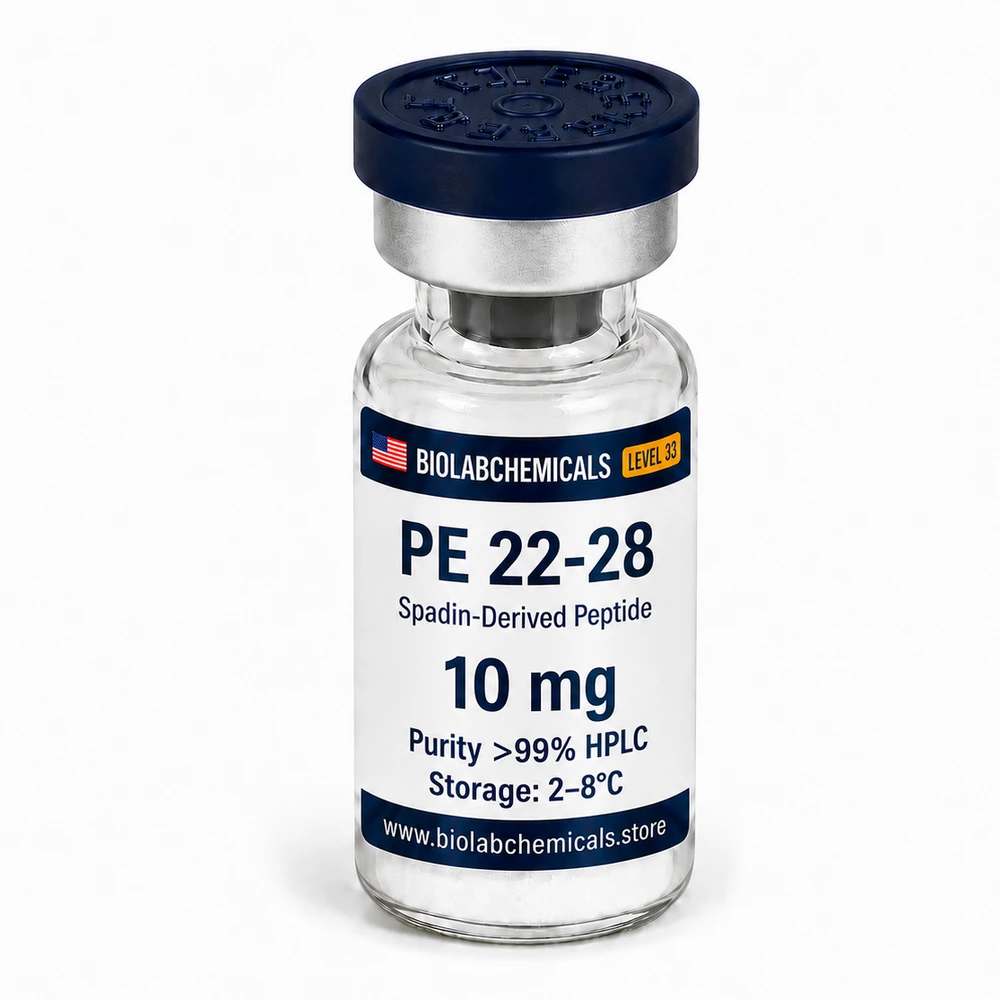
PE 22-28 is a synthetic heptapeptide (sequence GVSWGLR), also known as "mini-spadin." It corresponds to residues 22–28 of the propeptide of sortilin (NTSR3, neurotensin receptor 3), from which the natural peptide spadin is derived. PE 22-28 is the shortest fragment that retains spadin's activity, while being more potent, more stable and easier to manufacture (spadin itself has a cysteine and a disulfide bridge that complicate synthesis). It was identified by Djillani et al. in 2017.
Mechanism of Action
PE 22-28 is a selective inhibitor of the TREK-1 potassium channel (a two-pore-domain K⁺ channel abundant in hippocampal and cortical neurons that regulates cell excitability). Its affinity is very high: IC50 ≈0.12 nM — roughly 300–500 times more potent than the parent spadin (40–60 nM) — and it is selective for TREK-1, barely affecting related channels (TREK-2, TRAAK, TRESK, TASK-1); it blocks mainly the arachidonic-acid activation of the channel. The key rationale: mice with the TREK-1 gene knocked out show an antidepressant phenotype resistant to conventional antidepressants. By blocking this channel, PE 22-28 raises the excitability and signaling of serotonergic neurons, activates the MAPK and PI3K pathways (the latter linked to protection of cells from apoptosis), and triggers the cAMP/PKA cascade and BDNF production. Notably, the peptide does not act on the cardiac hERG channel (heart rate and blood pressure remain stable) and does not provoke seizures — on the contrary, it increases resistance to them.
Effects in Research
In rodent models of depression, PE 22-28 reduced immobility time in the forced swim test and shortened the latency to feed in the novelty-suppressed feeding test (markers of antidepressant activity) within just a few days — unlike classic SSRIs, which take 4–6 weeks, and without their characteristic side effects. After only 4 days, the peptide roughly doubled the number of new cells in the hippocampus (BrdU labeling), i.e. it induced neurogenesis, and enhanced synaptogenesis: levels of PSD-95 and synapsin rose, along with the proportion of mature dendritic spines (neuroplasticity), plus increased BDNF production. Because of these plasticity effects it is considered beyond depression: in post-stroke depression (where TREK-1 overexpression is involved), potentially in neurodegenerative diseases (Alzheimer's, Parkinson's), and in combination with conventional antidepressants for a faster onset. Compared with spadin, PE 22-28 acts longer (up to ~23 h versus ~7 h) and is more stable in vivo. To date all evidence is preclinical (rodents); there are no completed human studies.
Properties
White lyophilized powder, soluble in water. Sequence: Gly-Val-Ser-Trp-Gly-Leu-Arg (GVSWGLR). Formula C₃₅H₅₅N₁₁O₉, molecular weight ≈773.9 Da. CAS 1801959-12-5, PubChem CID 165437303. Synonym — PE 22-28 (acetate).
Storage
Store the lyophilized powder at 2–8°C in a dry place protected from light; for long-term storage −20°C is optimal. After reconstitution keep refrigerated, do not freeze, and use within a few weeks.
 BIOLABCHEMICALS