Message the manager to join our researchers' chat
Ask a question manager offline
UK RU EN
Мова
UK RU EN
Валюта
Shopping Cart
Catalog /Research Chemicals /Sephin1 acetate powder
Exclusive
In Stock
Sephin1 acetate powder

Sephin1 acetate powder

Sephin1 · Sephin-1 · Sephin 1 · Сефін1 · Сефин1 · Сефін-1 · Sephin1 acetate · Sephin1 ацетат · NSC 65390 · PPP1R15A inhibitor · GADD34 inhibitor · інгібітор GADD34 · похідне гуанабензу

Purity ≥95% HPLC · PASS
Specification
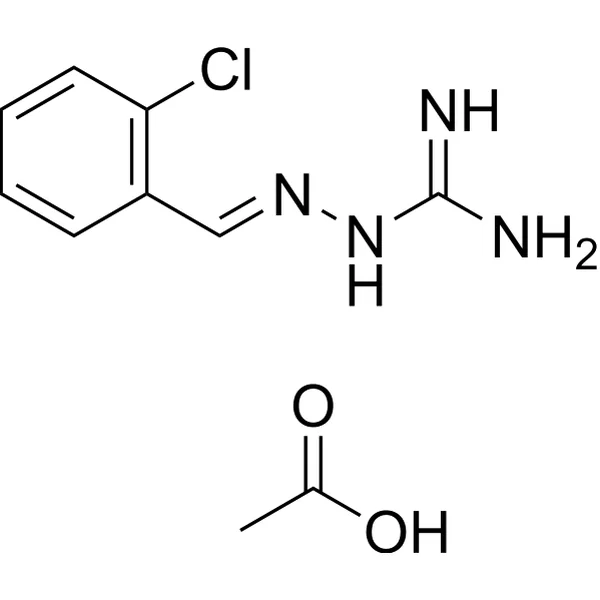
IUPAC(E)-2-(2-Chlorobenzylidene)hydrazine-1-carboximidamide acetate
CAS (free base)951441-04-6
FormulaC₁₀H₁₃ClN₄O₂
Mol. weight256.69 г/моль
Purity≥95% · HPLC
Formpowder
Place an order
$15.00
1
● In stock · we ship today before 17:00
Purity ≥95%, verified by HPLC
CoA for every lot
Nova Poshta, 1–2 days in Ukraine
Payment by card or USDT
Compound description

What is Sephin1 acetate powder

Sephin1 (from selective inhibitor of a holophosphatase) is a selective inhibitor of the protein phosphatase 1 regulatory subunit known as PPP1R15A or GADD34. We supply it as the acetate.

The mirror tool to ISRIB. Both molecules act on the integrated stress response, but from opposite sides. ISRIB restores protein synthesis by overriding the consequences of eIF2α phosphorylation. Sephin1 does the reverse — it prolongs the beneficial phase of that signal: it prevents the phosphatase from removing the phosphate from eIF2α, so the protective suppression of translation lasts longer. Together they give a researcher control over translational suppression in both directions.

Mechanism. PPP1R15A recruits the catalytic subunit PP1 to dephosphorylate eIF2α — and it is this step that terminates the stress response. Sephin1 binds PPP1R15A and blocks it. Phosphorylated eIF2α reduces overall protein synthesis and thereby prevents accumulation of misfolded proteins in the endoplasmic reticulum (Science, 2015).

Selectivity within the family. This is the principal design advantage. Sephin1 inhibits the stress-induced PPP1R15A but not the constitutive PPP1R15B (Science, 2015). The molecule therefore intervenes only where the stress programme is already running, leaving baseline translational control in healthy cells untouched.

A guanabenz derivative without guanabenz's off-target. Sephin1 was built from guanabenz but lacks the methoxy group and the second chlorine atom, and it is precisely this edit that eliminates α2-adrenergic activity while retaining phosphatase inhibition (Nat Rev Drug Discov, 2015). Guanabenz, as an α2 agonist, lowers blood pressure; Sephin1 delivers the proteostatic effect without that action.

Two unrelated diseases prevented in mice. A 2015 Science paper showed that Sephin1 safely and selectively inhibited a phosphatase regulatory subunit in vivo and prevented the motor, morphological and molecular defects of two entirely unrelated protein-misfolding diseases — Charcot-Marie-Tooth 1B and SOD1-mediated amyotrophic lateral sclerosis (Science, 2015). This established that phosphatase regulatory subunits are viable drug targets at all.

Protection of cells against proteotoxic stress. In vitro, Sephin1 protected cells from lethal protein misfolding and cytotoxic endoplasmic reticulum stress (Science, 2015).

Broad antiviral profile. Since eIF2α phosphorylation by the kinase PKR is one of the principal cellular antiviral mechanisms, Sephin1 was tested against viral replication. It downregulated replication of human respiratory syncytial virus, measles virus, human adenovirus 5, human enterovirus D68, human cytomegalovirus and rabbit myxoma virus, and raised levels of phosphorylated eIF2α in cells (Front Microbiol, 2019).

Supplied as a crystalline powder. The Sephin1 free base is registered under CAS 951441-04-6 (E-isomer).

For research use only. This product is not a medicine, food supplement or cosmetic. Not intended for human or animal use. Sold to persons aged 18+.