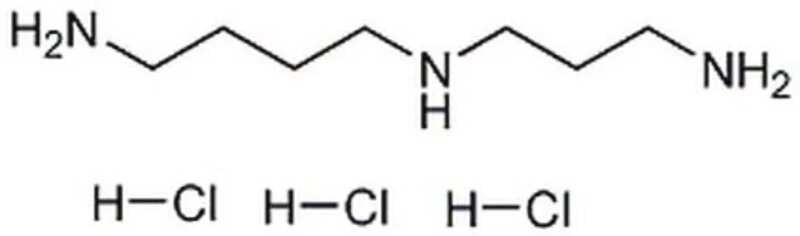
Supplied as the trihydrochloride salt (CAS 334-50-9, PubChem CID 9539) — a stable white crystalline solid, readily water-soluble (up to ~100 mM). The free base of spermidine (CAS 124-20-9) is an unstable liquid that deaminates over time even in solution and must be kept frozen; the trihydrochloride salt instead stores for up to 12 months at 0–8°C, which is why it's the form used in research and sold as a reagent.
Mechanism of Action
Spermidine is the substrate of deoxyhypusine synthase (DHPS), which hypusinates the translation factor eIF5A. Hypusinated eIF5A resolves ribosomal stalling at polyproline motifs and improves translation of ATG3 (autophagy) and TFEB (regulator of lysosomal biogenesis and PINK1/Parkin-mediated mitophagy) — an mTOR-independent route to autophagy induction.
NMDA Receptors
The action on NMDA receptors is concentration-dependent and two-sided. At micromolar concentrations, spermidine (like spermine) acts as a positive allosteric modulator of GluN2B-containing receptors: it binds an acidic pocket at the GluN1/GluN2B N-terminal domain (NTD) dimer interface, stabilizes the domain's "active" conformation, and increases channel open probability and current amplitude ("glycine-independent potentiation"), slowing desensitization. At higher concentrations, conversely, spermidine enters the channel pore and acts as a voltage-dependent blocker — similar to Mg²⁺ — and, given sufficient driving force, can even permeate the GluN1/GluN2A and GluN1/GluN2B channel together with Ca²⁺ (Km ≈ 2.2–2.7 mM), a flux that is suppressed by memantine. So the same site-mechanism can either boost or suppress NMDA current depending on dose and membrane potential.
Neurobiology
In mice, dietary spermidine crosses the blood-brain barrier and increases hippocampal eIF5A hypusination and mitochondrial respiration in aged animals, improving spatial learning in home-cage tasks (Schroeder et al., 2021, Cell Reports). In a mild cognitive impairment model, spermidine restored memory and GluA1 post-translational modifications via autophagy/lysosome-mediated clearance of amyloid fibrils (De Risi et al., 2020, Aging Cell). In aging SAMP8 mice, oral spermidine raised BDNF/NGF and antioxidant activity (SOD↑, MDA↓), reduced neuroinflammation (NLRP3, IL-1β, IL-18) and apoptosis (Bcl-2/Bax/caspase-3).
Human Data
A pilot RCT (Wirth et al., 2018, Cortex, n=28, older adults with subjective cognitive decline) found a moderate memory improvement versus placebo. The larger confirmatory Phase IIb SmartAge trial (Schwarz et al., 2022, JAMA Netw Open, n=100, 12 months) found NO statistically significant effect on memory or biomarkers overall versus placebo; researchers noted only an exploratory signal for verbal memory that needs validation at higher doses. The clinical picture is therefore still unsettled.
Storage
Store in a freezer, airtight container, protect from moisture.