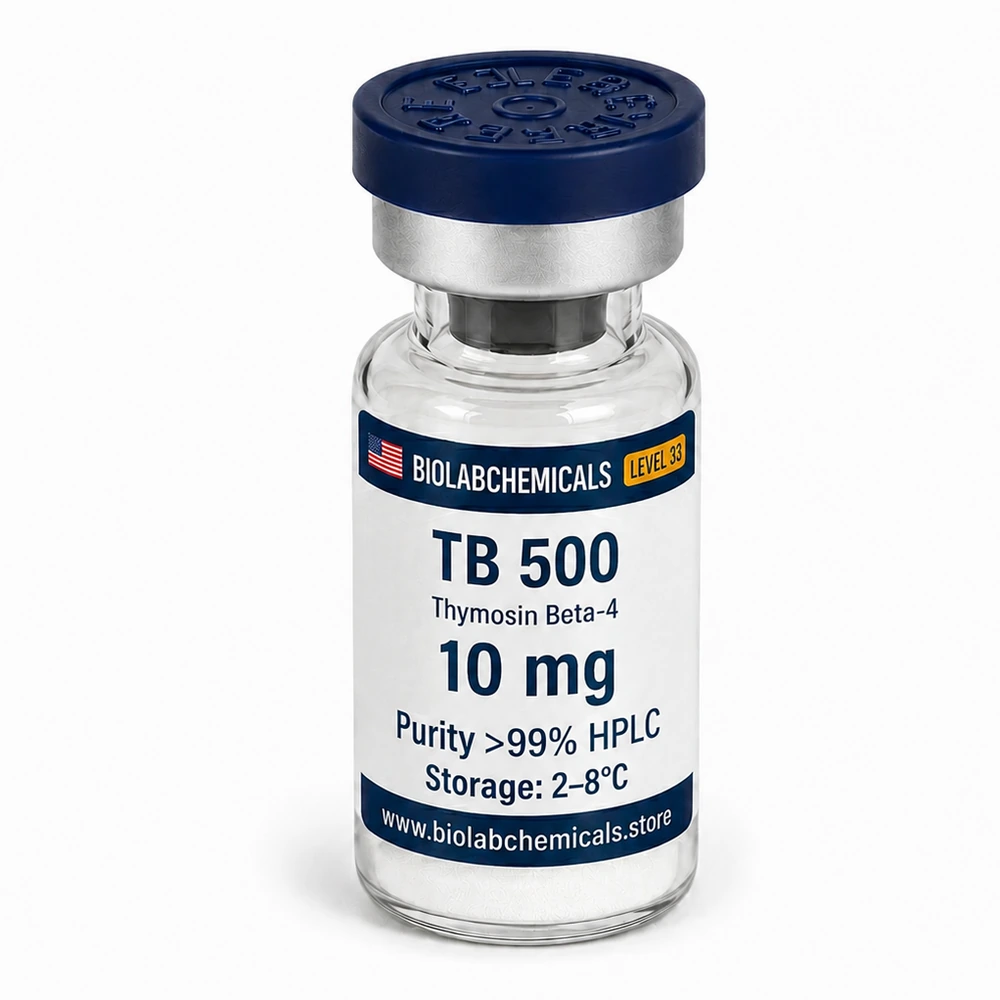
TB-500 is an injectable synthetic heptapeptide, Ac-LKKTETQ, corresponding to the active region (residues 17–23) of natural thymosin β4 (Tβ4). It is the short, N-terminally acetylated fragment responsible for the actin-binding and regenerative activity of the parent protein, but simpler and more stable than the full 43-amino-acid Tβ4.
Mechanism of Action
The key function of TB-500 is binding and sequestering monomeric (G-)actin, thereby regulating polymerization of the actin cytoskeleton. The LKKTETQ motif is the actin-binding active site within thymosin β4. By controlling actin dynamics, the peptide facilitates cell migration to sites of injury, stimulates the formation of new blood vessels (angiogenesis), and promotes extracellular-matrix remodeling.
Effects in Research
In preclinical models, TB-500 accelerates wound healing, supports endothelial-cell differentiation and dermal angiogenesis, enhances keratinocyte migration and collagen deposition, and shows anti-inflammatory, antioxidant and cardioprotective activity. It is studied in the context of soft-tissue, tendon and muscle repair, wound healing, and myocardial and vascular regeneration. Historically, synthetic TB-500 emerged as a veterinary preparation (notably for horses).
Key Research
The best-known study is Bock-Marquette et al. (Nature, 2004): in mice after myocardial infarction, thymosin β4 activated the ILK/Akt pathway, supported cardiac-cell survival and migration, reduced scarring and improved heart function — launching a decade of cardioprotection research. In ophthalmology, full-length Tβ4 (RGN-259, RegeneRx) advanced to Phase 3 clinical trials for dry-eye disease and neurotrophic keratopathy, though results were mixed. In neuroscience, Tβ4 improved recovery in rodent stroke and traumatic-brain-injury models, promoting remyelination. Separate studies reported faster Achilles-tendon healing and stimulation of hair growth. Most of these data come from full-length Tβ4; the Ac-LKKTETQ fragment retains the parent peptide's core actin-binding activity.
Properties
White to off-white lyophilized powder, readily water-soluble (≥200 mg/mL). Sequence: Ac-Leu-Lys-Lys-Thr-Glu-Thr-Gln (Ac-LKKTETQ). Formula C₃₈H₆₈N₁₀O₁₄, molecular weight ≈889 Da. CAS 885340-08-9, PubChem CID 62707662.
Storage
Store the lyophilized powder at 2–8°C in a dry place protected from light; for long-term storage −20°C is optimal. After reconstitution keep refrigerated, do not freeze, and use within a few weeks.
 BIOLABCHEMICALS